


99213 CPT Code: Description and Usage Guidelines
In medical billing and coding, just five numbers can decide whether you get paid for the care you provide or whether your claim is denied. Those five numbers are CPT codes, and using the correct one is essential for accurate reimbursement.
Among the more than 11,000 standardized CPT codes, CPT code 99213 is one of the most commonly used. In this guide, you’ll learn what it means, when to use it, common real-life examples, and important billing tips to help improve claim approval and reimbursement.
Let’s understand CPT code 99213 with confidence.
Table of Contents
ToggleWhat is CPT Code 99213?
CPT code 99213 is a Current Procedural Terminology (CPT) code used to report a level 3 Evaluation and Management( E/M ) visit for an established patient in an office or outpatient setting. The visit usually lasts 20 or more minutes and involves low-complexity medical decision-making.
During the visit, the healthcare provider reviews the patient’s medical history, performs a focused physical examination when needed, evaluates the current treatment plan, and decides whether any changes are required.
Like all other CPT codes, CPT code 99213 is maintained by the American Medical Association (AMA). It is part of a standardized coding system that helps healthcare providers and insurance companies communicate clearly and process claims correctly.
To fully understand CPT code 99213, you should first know these three important concepts.
Evaluation and Management (E/M) Visits
Evaluation and Management visits include routine office visits, follow-up appointments, outpatient visits, emergency department visits, preventive exams, and consultations. During these visits, healthcare providers evaluate the patient’s condition, diagnose illnesses or injuries, monitor progress, and provide treatment.
These visits may be simple follow-up appointments or more detailed evaluations, depending on the patient’s condition.
Low-Complexity Medical Decision-Making
Low-complexity medical decision-making usually applies when a patient has a stable chronic condition or a minor acute illness or injury that does not require extensive testing or complicated treatment.
The provider typically spends about 20 to 29 minutes with the patient, reviews symptoms, evaluates progress, discusses concerns, and updates the treatment plan if necessary. Since the patient’s condition is generally stable, the medical decision-making remains low in complexity.
Established Patient
An established patient is someone who has received professional medical services from the same provider or another provider of the same specialty within the same group practice during the past three years.
Scenarios Where CPT Code 99213 is Applicable
There are many situations where an established patient may visit a healthcare provider without needing extensive testing or complex treatment. The following examples show when CPT code 99213 is appropriate.
Follow-up Visit for a Patient with a Fractured Arm
Imagine a patient who fractured an arm about a month ago. The orthopedic specialist treated the injury, aligned the broken bone, and applied a cast.
Four weeks later, the patient returns for a follow-up visit. The orthopedist checks the patient’s pain level, examines hand movement, looks for swelling or skin problems, and evaluates how well the bone is healing. If needed, the provider adjusts medications or recommends additional treatment.
Since this is a follow-up visit for an established patient with low-complexity medical decision-making, it is reported using CPT code 99213.
Routine Check-up for a Diabetic Patient
Diabetes is a long-term condition that requires regular monitoring.
Suppose an established patient with diabetes visits the primary care physician for a routine follow-up. The provider asks about blood sugar control, weight changes, wounds, diet, and other health concerns. The physician also checks blood pressure, weight, blood sugar levels, and looks for signs of related conditions such as hypertension or obesity.
Because this visit involves ongoing management of a stable chronic condition with low-level medical decision-making, the provider reports CPT code 99213.
Management Visit for Medication Side Effects
CPT code 99213 can also be used when an established patient visits the provider because of medication side effects.
For example, a patient receiving treatment for depression meets with a clinical psychologist and reports weight gain, insomnia, and excessive sweating caused by antidepressant medications.
After reviewing the patient’s condition, the psychologist adjusts the medication dosage and recommends changes to the patient’s diet and treatment plan to reduce the side effects.
Since this is a level 3 Evaluation and Management (E/M) visit involving low-complexity medical decision-making, the visit is billed with CPT code 99213.
X-Ray Interpretation for Asthma Monitoring
Asthma is another chronic condition that often requires regular follow-up care.
Suppose a patient with severe asthma returns to the outpatient clinic after completing a chest X-ray. The specialist reviews the imaging results, explains the findings, identifies signs of pulmonary hyperinflation, and updates the patient’s treatment plan by prescribing medications and teaching breathing exercises.
Because this follow-up visit involves reviewing diagnostic results and making low-complexity medical decisions for an established patient, the provider reports CPT code 99213.
Diagnosis and Treatment of Cold Sores
Consider a patient with lupus who visits the healthcare provider after developing blisters around the lips and mouth.
The provider examines the affected area, diagnoses the condition as cold sores caused by the herpes simplex virus, and explains that the weakened immune system increased the risk of infection. The provider then prescribes antiviral creams and oral medications.
Although the patient has a new illness, the diagnosis and treatment do not require extensive testing or complicated medical decision-making. Therefore, the visit is appropriately reported with CPT code 99213.
Things to Consider While Billing CPT Code 99213
Knowing when to report CPT code 99213 is only one part of successful medical billing. To receive proper reimbursement, every step of the billing process should support your code selection and clearly demonstrate medical necessity.
Here are some important billing tips to remember.
Include All Components of CPT Code 99213
Make sure your documentation covers all the required elements of CPT code 99213.
Record the Patient's Medical History
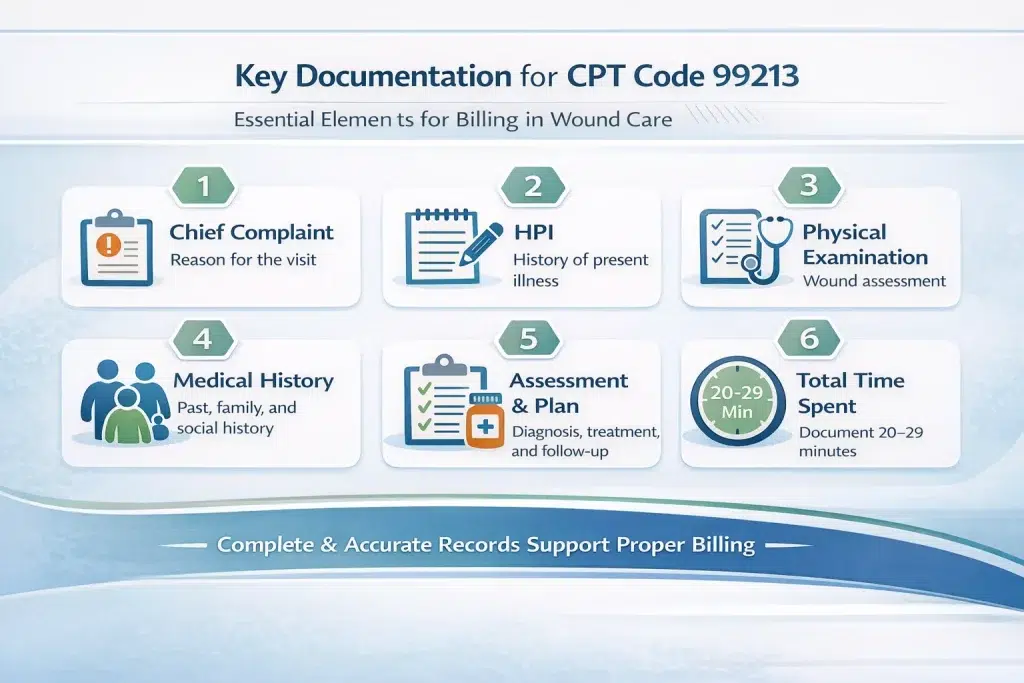
Start by documenting the patient’s focused medical history. This includes the chief complaint, history of the present illness, review of current symptoms, and any relevant past medical, family, or social history related to the patient’s condition.
Examine the Patient's Current Condition
The provider should perform an expanded problem-focused examination based on the patient’s complaint. This may include checking vital signs and examining the affected body system, such as the heart, lungs, joints, or other areas related to the visit.
Document Medical Decision-Making
Medical decision-making is the most important part of CPT code 99213.
The visit should involve low-complexity medical decision-making, which generally means the provider manages one or two conditions, reviews limited clinical data, and treats a patient with a low-risk or stable condition.
Maintain Complete Documentation
Complete documentation is essential to support medical necessity.
The patient’s medical history, examination findings, diagnosis, treatment plan, medication changes, and follow-up recommendations should all be clearly documented and submitted with the insurance claim. Accurate documentation helps reduce claim denials and supports faster reimbursement.
Ensure Time-Based Coding
When reporting CPT code 99213, document the total time spent during the visit whenever time is used to support code selection.
For example, if the provider spends 20 minutes with the patient and 12 of those minutes are used to teach asthma breathing exercises or provide counseling, this should be clearly documented in the medical record.
Use Modifiers When Appropriate
Modifiers give insurance payers additional information about the services performed.
If needed, attach the correct modifier to CPT code 99213 to explain special circumstances. For example, Modifier 25 is used when the Evaluation and Management ( E/M )service is significant and separately identifiable from another procedure performed on the same day.
The Takeaway
CPT code 99213 is one of the most frequently reported codes for outpatient office visits. Correct coding, complete documentation, and following proper billing guidelines can greatly improve reimbursement rates and reduce claim denials.
Remember that CPT code 99213 is used for an Evaluation and Management ( E/M ) service provided to an established patient in an office or outpatient setting when the visit involves low-complexity medical decision-making. To support this code, providers should properly document the patient’s focused history, perform a focused examination, and clearly record their medical decision-making.
If medical coding feels overwhelming, let the experts at Medmax RCM handle it for you. Our HIPAA-certified medical coders provide accurate coding and documentation services to help ensure your CPT code 99213 claims are submitted correctly and processed successfully on the first attempt.
Frequently Asked Question (FAQs)
What is the 99212 CPT code?
CPT code 99212 is for an Office/Outpatient Visit for an Established Patient with straightforward medical decision-making, typically involving 10-19 minutes of total time, and addressing a self-limited or minor problem. It’s the lowest-level evaluation and management (E/M) code for returning patients, used for routine follow-ups, medication adjustments for stable conditions, or simple health concerns.
What is the 99213 CPT code?
CPT code 99213 describes an office or outpatient visit for an established patient, involving a moderate level of complexity for evaluation and management (E/M) services, typically lasting 20-29 minutes, often for stable chronic conditions or minor new problems, requiring at least two of three components: history, exam, and low-complexity medical decision-making (MDM).
What is the 99214 CPT code?
CPT code 99214 describes an office or outpatient visit for an established patient, requiring a medically appropriate history/exam and a moderate level of medical decision-making (MDM), often taking 30-39 minutes of total time, used for managing more complex or chronic conditions.
What is CPT code 99213 used for?
CPT code 99213 is for an established patient’s office visit that involves a low-complexity level of medical decision-making or a total time of 20-29 minutes, used for routine follow-ups for stable chronic conditions (like managed hypertension) or minor acute issues (like a simple infection).
What services does CPT code 99213 cover?
CPT code 99213: Established patient office or other outpatient visit, 20-29 minutes. As the authority on the CPT code set, the AMA is providing the top-searched codes to help remove obstacles and burdens that interfere with patient care.
When to use 59 or 51 modifier?
Use Modifier 51 for multiple surgical procedures in the same session (telling payers which is primary vs. secondary for payment reduction) and Modifier 59 (Distinct Procedural Service) to override National Correct Coding Initiative (NCCI) edits when two bundled services were actually separate (e.g., different sites, encounters, incisions). Modifier 59 is the “modifier of last resort,” used to signal a legitimate exception to bundling rules, while 51 manages payment sequencing for typically related services.
What is the 99213 CPT code used for in wound care?
CPT code 99213 in wound care is for an Evaluation & Management (E/M) visit for an established patient with a stable chronic illness or uncomplicated injury, requiring low complexity medical decision-making, such as routine follow-up, medication management, or adjusting a treatment plan, often involving around 20-29 minutes of face-to-face time.
When should wound care providers use 99213 vs 99214?
Wound care providers use 99213 for low complexity visits (20-29 mins, stable issues, minimal data/risk) and 99214 for moderate complexity visits (30-39 mins, multiple or complex issues, moderate data/risk), choosing based on the patient’s condition, data reviewed (labs, imaging), treatment decisions, and time spent, with 99214 indicating a more in-depth assessment than 99213.







Jessica Collins
Jessica Collins is a Certified Professional Coder (CPC) specializing in medical billing services and revenue cycle management (RCM). She works closely with healthcare providers and medical billing companies to streamline claim processing, reduce denials, and enhance reimbursement efficiency.