

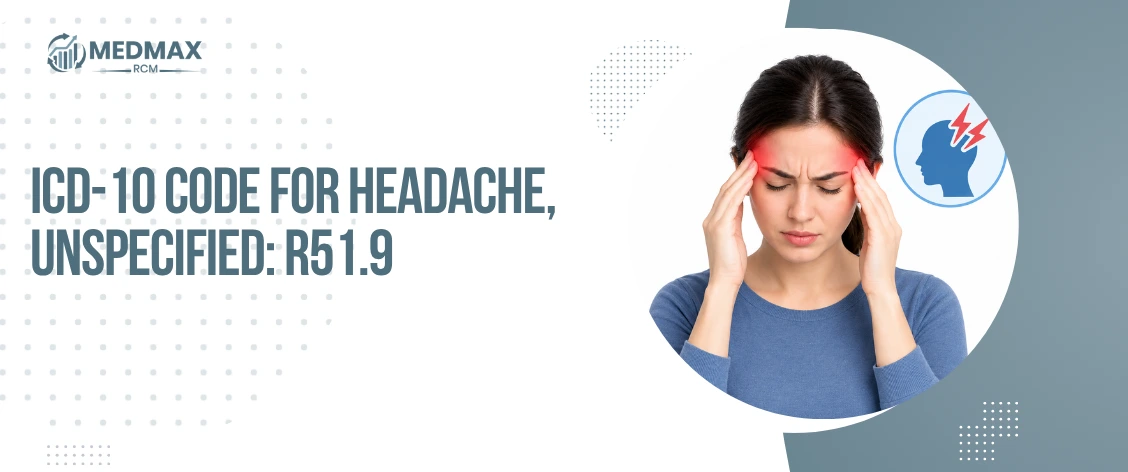
When Should You Use ICD-10 Code R51.9 for Headaches?
Headaches are among the most common complaints in clinical practice. They affect millions of people worldwide and can range from mild discomfort to debilitating pain. Properly coding headaches is essential for accurate documentation, appropriate treatment, and correct reimbursement.
The ICD-10-CM code R51.9 specifically applies to headaches that are documented without further specification. In this article, we’ll explore when it’s appropriate to use R51.9, how it compares with other headache codes, and tips for documentation and billing.
Table of Contents
ToggleUnderstanding ICD-10 Code R51.9
The ICD-10-CM code R51.9 is defined as “Headache, unspecified.” It is used when a patient presents with a headache but the documentation does not identify a more specific headache type or diagnosis.
Key facts about R51.9:
- Full Code: R51.9 – Headache, unspecified
- Chapter: Symptoms, signs and abnormal clinical and laboratory findings, not elsewhere classified
- Parent Category: R51 – Headache
When Should You Use R51.9?
Lack of a Specific Diagnosis
If a patient reports a headache and the provider documents no more specific headache diagnosis, R51.9 may be appropriate.
- Scenario: A patient visits for a routine checkup and mentions occasional headaches. The provider documents “headache” in the assessment without specifying the type.
- Potential Code: R51.9, provided the documentation supports its use.
Initial Encounters
During an initial evaluation, the provider may not yet have enough information to establish a more specific headache diagnosis. In such cases, R51.9 may be appropriate if the documented assessment remains unspecified.
The code should reflect the provider’s documented diagnosis for that encounter rather than an assumed cause or headache type.
Documentation Limitations
Sometimes, the available clinical information does not establish the cause or type of headache. If the provider documents only “headache,” R51.9 may be appropriate. Coders should review the complete medical record and follow applicable ICD-10-CM coding guidelines.
When Not to Use R51.9
When a Specific Headache Type Is Documented
If the provider documents a specific headache disorder, use the appropriate code rather than R51.9 when supported by the applicable coding guidelines.
Examples include:
- Migraine: G43.- series
- Tension-type headache: G44.2- series
- Cluster headache: G44.0- series
- Medication-overuse headache: G44.4- series
The final code selection depends on the documented diagnosis and any additional coding requirements.
Secondary Headache Disorders
When a headache is associated with another medical condition, such as sinusitis, trauma, or infection, review the documentation and applicable coding guidelines to determine the appropriate code or codes.
Do not automatically assign R51.9 when a more specific diagnosis is documented. However, whether an additional headache code is appropriate depends on the circumstances and coding instructions.
Common Documentation Scenarios
The following examples illustrate how documentation can affect code selection. Actual coding should always be based on the provider’s assessment and the applicable ICD-10-CM guidelines.
Nonspecific Headache Complaint
Documentation: The patient reports intermittent headaches with no additional headache diagnosis documented. No neurological deficits are noted.
Potential Code: R51.9 – Headache, unspecified.
Migraine Identified
Documentation: The provider diagnoses migraine without further specifying the subtype, intractability, or status migrainosus.
Potential Code: G43.909 – Migraine, unspecified, not intractable, without status migrainosus, if the documentation supports all elements of this code.
Headache Associated With Sinusitis
Documentation: The provider diagnoses acute maxillary sinusitis and documents an associated headache.
Potential Code: J01.00 – Acute maxillary sinusitis, unspecified, when supported by the documentation. An additional headache code should be considered only when appropriate under the applicable coding guidelines.
The Importance of Accurate Documentation
Accurate documentation is essential for appropriate diagnosis coding, medical necessity, and reimbursement. Providers should document relevant headache characteristics whenever possible.
Tips for better documentation:
- Specify the type: Document whether the diagnosis is migraine, tension-type headache, cluster headache, or another condition when established.
- Note the duration: Include relevant details about the onset, duration, frequency, and pattern of the headache.
- Record associated symptoms: Document relevant symptoms such as nausea, photophobia, or aura when present.
- Identify relevant factors: Include documented triggers, injuries, medications, or underlying conditions when clinically relevant.
When the provider documents only an unspecified headache, R51.9 may be appropriate. More detailed documentation can support more accurate code selection when a specific diagnosis is established.
Medical Coding Guidelines for R51.9
Use the Code When Supported by the Documentation
Use R51.9 when the documented diagnosis is an unspecified headache and no more specific code is supported. Review the full medical record and follow the applicable ICD-10-CM guidelines.
Check for More Specific Diagnoses and Exclusions
Do not use R51.9 as a substitute for a documented specific headache disorder. Review the official code descriptions, inclusion and exclusion notes, and any applicable coding instructions before assigning the final code.
For example, post-traumatic headaches and certain secondary headache disorders may require different codes depending on the documented diagnosis.
Assign Additional Codes When Appropriate
If a headache occurs alongside other symptoms or diagnoses, determine whether additional codes are required or appropriate. For example, a patient with headache, fever, and sore throat may require coding for a diagnosed infection and other relevant conditions, depending on the encounter documentation and coding guidelines.
Headache Coding Table: R51.9 vs. Other Codes
| Condition | ICD-10 Code | Description |
|---|---|---|
| Headache, unspecified | R51.9 | Headache, unspecified |
| Migraine | G43.x | Migraine variants |
| Tension-type headache | G44.2 | Tension-type headache |
| Cluster headache | G44.0 | Cluster headache syndromes |
| Medication overuse headache | G44.4 | Headache due to drug overuse |
| Post-traumatic headache | G44.3 | Headache after injury |
Medical Billing Tips for R51.9
Support Medical Necessity
Insurance payers may require documentation supporting the medical necessity of a visit, test, or procedure. Ensure the medical record explains the reason for the encounter and supports the services provided.
Avoid Unsupported or Incomplete Coding
Use R51.9 when appropriate, but do not select a more specific code unless the documentation supports it. Accurate coding and complete documentation help reduce avoidable claim errors and support compliance.
Link Diagnoses to Procedures When Appropriate
If a diagnostic procedure, such as a CT scan or laboratory test, is performed because of a headache, ensure the documentation supports the clinical indication and medical necessity of the service.
Review Payer and Official Coding Guidelines
Payer requirements may vary. Review applicable payer policies, official ICD-10-CM guidelines, and relevant coverage determinations when evaluating coding and billing requirements.
Case Studies: R51.9 in Practice
Case 1: Annual Physical With a Headache Complaint
A 45-year-old patient attends an annual physical and mentions mild headaches occurring once a month. The provider documents “occasional headache” without establishing a more specific diagnosis.
- Potential Code: R51.9, if supported by the documentation and appropriate for the encounter.
Case 2: Headache With Fever
A child presents with a headache and fever. The provider diagnoses acute pharyngitis.
- Potential Code: J02.9 – Acute pharyngitis, unspecified, if supported by the documentation.
- An additional headache code is not automatically necessary when the headache is part of the diagnosed illness. Follow the applicable coding guidelines.
Case 3: Headache After a Fall
A patient reports a severe headache after a recent fall, and imaging is ordered.
Coding Consideration: Review the provider’s assessment, injury documentation, and applicable coding guidelines to determine the appropriate code. A post-traumatic headache code may be appropriate when that diagnosis is documented and supported.
Frequently Asked Questions
Can You Use R51.9 for All Headaches?
No. R51.9 is used for headaches documented without further specification. If the provider establishes a more specific headache diagnosis, select the appropriate code according to the documentation and applicable coding guidelines.
What Happens If You Overuse R51.9?
Repeated use of unspecified codes may indicate opportunities to improve documentation. In some circumstances, incomplete or unsupported coding can contribute to claim questions, denials, or compliance concerns. However, R51.9 is appropriate when the documentation supports an unspecified headache.
Should You Use Additional Symptom Codes Alongside R51.9?
Additional symptom codes may be appropriate when other symptoms are separately relevant to the encounter and coding guidelines permit or require their reporting. Review the documentation and applicable instructions before assigning additional codes.
The Role of Clear Language in Clinical Documentation
Clear documentation helps coders understand the provider’s assessment and supports appropriate code selection. Transition words can improve the organization of clinical notes when they accurately reflect the clinical reasoning.
For example:
- “Initially, the patient reported a headache.”
- “Additionally, the patient reported nausea.”
- “Based on the clinical assessment, further evaluation was ordered.”
Active voice can also make documentation easier to understand. Instead of writing, “A headache was reported by the patient,” write, “The patient reports a headache.”
The goal is to make clinical documentation clear, accurate, and consistent with the care provided.
How R51.9 Impacts Quality Reporting
Healthcare organizations use coding data for various administrative, operational, and quality-reporting purposes. Accurate coding helps ensure that clinical information is represented appropriately.
Ways to improve documentation and coding quality include:
- Encouraging providers to document specific headache diagnoses when established.
- Using R51.9 when the documentation supports an unspecified headache.
- Training coding staff to follow current ICD-10-CM guidelines.
- Reviewing coding patterns to identify opportunities for documentation improvement.
An unspecified code is not inherently incorrect. Its appropriateness depends on the information documented and the coding rules applicable to the encounter.
Conclusion
ICD-10-CM code R51.9 is used to report a headache when the documented diagnosis remains unspecified. Selecting the correct code requires careful review of the medical record, the provider’s assessment, and the applicable coding guidelines.
By documenting relevant headache characteristics and selecting codes that accurately reflect the clinical record, healthcare providers and medical coders can support appropriate billing, reduce avoidable coding errors, and improve documentation quality.
Always verify the current official ICD-10-CM code descriptions and guidelines before submitting a claim, as coding requirements may change.
Your team may be doing everything right—but hidden billing issues could still be costing you thousands. Let us review your process and show you where you’re losing revenue. Message us today for a quick review.
- No more resubmitting again and again 97% Claim Approval Rate
- No delays, no backlog, just clean submissions 24-hour Claim Turnaround
- 100% HIPAA-compliant, audit-proof systems HIPAA Compliance
- Track every dollar and denial in real time Weekly, Monthly Reports




Jessica Collins
Jessica Collins is a Certified Professional Coder (CPC) specializing in medical billing services and revenue cycle management (RCM). She works closely with healthcare providers and medical billing companies to streamline claim processing, reduce denials, and enhance reimbursement efficiency.