

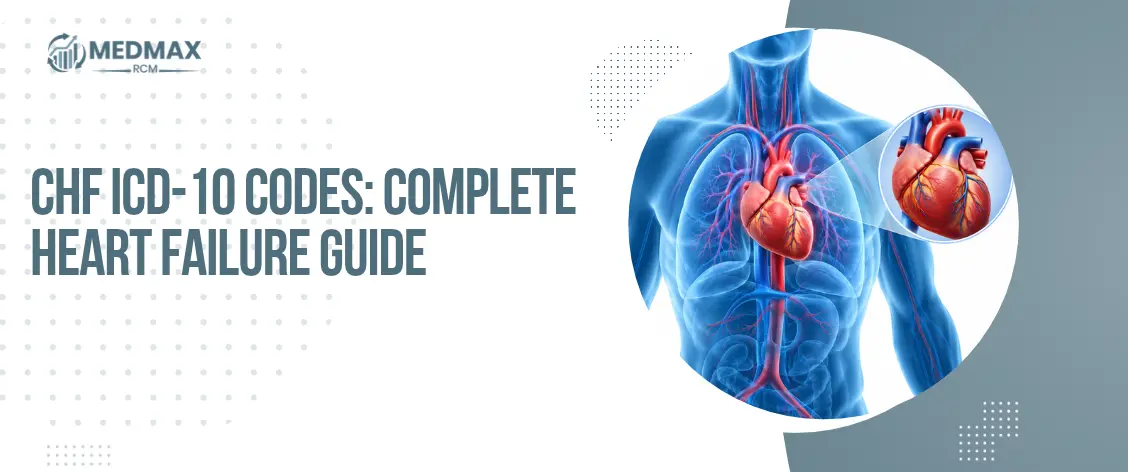
CHF ICD-10 Codes: Complete Heart Failure Guide
According to the Heart Failure Society of America’s HF Stats 2025 report, approximately 6.7 million Americans aged 20 and older currently live with heart failure. Projections suggest that this number may increase to 8.7 million by 2030, 10.3 million by 2040, and 11.4 million by 2050.
The lifetime risk of heart failure (HF) is now estimated at 24%, meaning about 1 in 4 people may develop the condition during their lifetime. Each patient encounter requires accurate coding, and the provider’s documentation is essential for ensuring that the assigned ICD-10-CM code reflects the patient’s documented condition.
Across this many encounters, correctly applying the I50 code hierarchy instead of defaulting to I50.9 can help prevent hundreds or even thousands of coding errors each year within a single practice or hospital.
This guide explains the I50 code family, the documentation required to support code selection, and common coding mistakes that may affect claim accuracy.
Table of Contents
ToggleThe Complete ICD-10-CM I50 Code Hierarchy
Before assigning an ICD-10-CM heart failure code, consider two key questions:
Question 1: What type of heart failure is documented?
This refers to the documented type of dysfunction and the part of the heart affected.
Question 2: What is the current acuity?
Acuity describes the documented clinical status: acute, chronic, or acute on chronic. Both the type and acuity help determine code specificity. When the record supports a more detailed diagnosis, using an unspecified code may reduce accuracy and prompt questions during an audit.
Include both elements in the final code when supported by the provider’s documentation. The hierarchy below follows the FY2026 billable code structure in the CMS ICD-10-CM Tabular List.
I50.1: Left Ventricular Failure, Unspecified
I50.1 (Left ventricular failure) identifies the location of the failure. Although related terms may appear as approximate synonyms in the tabular list, coders should select the most specific I50.x code supported by the provider’s documentation. This distinction helps support accurate code assignment and reduce avoidable errors.
What I50.1 tells you:
- It identifies the location of the failure: the left ventricle.
- It does not specify the mechanism, such as a problem with pumping, filling, or both.
The CMS FY2026 Tabular List may include approximate synonyms associated with I50.1, such as:
- Acute left-sided congestive heart failure
- Chronic left-sided congestive heart failure
- Congestive heart failure, left ventricle
When the provider clearly documents left ventricular systolic dysfunction, reduced ejection fraction, HFrEF, or systolic heart failure, use an I50.2x code rather than I50.1. Approximate synonyms do not override the requirement to assign the most specific code supported by the provider’s documentation.
When to use I50.1:
- The provider documents “left ventricular failure,” “left-sided heart failure,” or “left heart failure.”
- The note does not provide additional detail about the mechanism.
- The workup is ongoing and the type of heart failure has not yet been confirmed.
When NOT to use I50.1:
- The provider also documents reduced ejection fraction or systolic dysfunction; use I50.2x when supported.
- The provider documents preserved ejection fraction or diastolic dysfunction; use I50.3x when supported.
I50.1 does not have acuity-specific subcategories, so it cannot distinguish acute from chronic failure. When the documentation establishes both the mechanism and acuity, a code from the I50.2x or I50.3x series may describe the condition more precisely. The following sections explain how these distinctions guide code selection.
I50.2 Series: Systolic Heart Failure (HFrEF)
Systolic heart failure occurs when the heart’s pumping function is impaired and is commonly associated with heart failure with reduced ejection fraction (HFrEF). The 2022 AHA/ACC/HFSA Guideline for the Management of Heart Failure defines HFrEF as a left ventricular ejection fraction (LVEF) of 40% or less.
Important coding rule: An ejection fraction (EF) value alone does not determine the code. The provider must document “systolic heart failure,” “HFrEF,” “reduced ejection fraction,” or equivalent language in the assessment or plan. A reduced EF shown only in a test report, without a provider-documented diagnosis, does not satisfy this coding requirement.
| Code | Full Description | Use When |
|---|---|---|
| I50.20 | Systolic heart failure, unspecified | The provider documents systolic HF but does not specify whether it is acute or chronic. |
| I50.21 | Acute systolic heart failure | Systolic HF is newly diagnosed or has acutely worsened without an established chronic diagnosis. |
| I50.22 | Chronic systolic heart failure | Systolic HF is established, ongoing, and under active management. |
| I50.23 | Acute on chronic systolic heart failure | A patient with established chronic systolic HF has active decompensation or worsening symptoms. |
I50.3 Series: Diastolic Heart Failure (HFpEF)
Diastolic heart failure involves impaired relaxation and filling of the left ventricle and is commonly associated with heart failure with preserved ejection fraction (HFpEF). Under the 2022 guideline, HFpEF is defined as an LVEF of 50% or higher, along with signs of increased left ventricular filling pressures, such as elevated natriuretic peptides or abnormal Doppler filling studies. In this condition, the heart’s pumping function is preserved, but filling is impaired.
| Code | Full Description | Use When |
|---|---|---|
| I50.30 | Diastolic heart failure, unspecified | The provider documents diastolic HF but does not specify whether it is acute or chronic. |
| I50.31 | Acute diastolic heart failure | Diastolic HF is newly diagnosed or has acutely worsened without a prior chronic diagnosis. |
| I50.32 | Chronic diastolic heart failure | Diastolic HF is established, stable, and under ongoing management. |
| I50.33 | Acute on chronic diastolic heart failure | A patient with established chronic diastolic HF has active decompensation. |
In some patients, the documentation will not let the coder place the dysfunction clearly on one side of the systolic-versus-diastolic divide, because both mechanisms are named in the provider’s assessment and both need to be reflected in the code.
I50.4 Series: Combined Systolic and Diastolic Heart Failure
I50.4x applies when the provider clearly documents that both systolic dysfunction and diastolic dysfunction are present at the same time. Do not use this as a default for uncertain cases; the provider must document both systolic and diastolic dysfunction.
The acuity subcategories follow the same structure:
- I50.40: Combined HF, acuity not specified
- I50.41: Acute combined systolic and diastolic HF
- I50.42: Chronic combined systolic and diastolic HF
- I50.43: Acute on chronic combined systolic and diastolic HF
All of the codes covered so far address left-sided or biventricular dysfunction, but right ventricular failure follows a separate coding logic in FY2026, with its own subcategory series, its own sequencing rules, and an important distinction between failure that starts in the right ventricle on its own and failure that develops because of left-sided disease.
I50.81 Series: Right Heart Failure
Right heart failure in ICD-10-CM FY2026 is coded under the I50.81x series. Do not use I50.0 for right heart failure. Always follow the current CMS ICD-10-CM Tabular List.
The current billable right heart failure codes are:
- I50.810: Right heart failure, unspecified
- I50.811: Acute right heart failure
- I50.812: Chronic right heart failure
- I50.813: Acute on chronic right heart failure
- I50.814: Right heart failure due to left heart failure (right ventricular failure secondary to left ventricular failure); use with a “code also” for the type of left ventricular failure (I50.2x through I50.43), if known.
- I50.82: Biventricular heart failure; use when both ventricles are failing and the provider documents biventricular failure.
- I50.83: High output heart failure; use when the provider clearly documents high output heart failure.
- I50.84: End stage heart failure; use when the provider documents end stage or Stage D heart failure.
- I50.89: Other heart failure; use when the provider documents a specific type of heart failure that does not fit any other defined I50.x subcategory but is more specific than “unspecified” (I50.9).
Key distinction: When right heart failure develops directly because of left-sided dysfunction, assign I50.814 (Right heart failure due to left heart failure), with a “code also” instruction to add the applicable left-sided code (I50.2x, I50.3x, or I50.4x) if the type of left ventricular failure is known.
The I50.810 to I50.813 codes are used when right ventricular failure is independent or linked to pulmonary causes such as chronic cor pulmonale (I27.81) or pulmonary embolism. When chronic cor pulmonale is the documented condition, code I27.81 first, then add I50.81x if right heart failure is also clearly stated.
On the opposite end of the specificity range from all of these detailed subcategories is a single code that is both fully valid and frequently overused. Knowing when it is appropriate also requires understanding when its use may be a documentation-driven coding error.
I50.9: Heart Failure, Unspecified
I50.9 is a valid, billable ICD-10-CM code that is not wrong when used correctly. The concern is inappropriate use when the available documentation supports a more specific code.
When I50.9 is correct:
- The provider’s note says only “heart failure” or “congestive heart failure,” with no further detail.
- The encounter is early in a workup and the type has genuinely not yet been determined.
- No diagnostic data or clinical history in the available record clarifies the mechanism.
When I50.9 is a coding error:
- The problem list shows I50.9 from an older visit, but current encounter documentation clearly supports a specific type. The code should be reviewed and updated to reflect the current documentation.
- The provider used “HFrEF” or “HFpEF” in the history section but wrote only “CHF” in the assessment. A clinical documentation improvement (CDI) query may be appropriate to clarify the assessment.
A targeted query can be especially useful when the clinical presentation is similar but the documented heart failure type would lead to different code assignment and care classifications.
HFrEF vs HFpEF: The Clinical Difference and What It Means for Coding
The distinction between HFrEF and HFpEF is clinically important and can be lost when an unspecified code is used despite more detailed documentation. The breakdown below follows the 2022 guideline.
HFrEF (Maps to I50.2x)
What is happening physiologically:
- The left ventricle may be enlarged, and the heart muscle’s pumping strength may be reduced.
- Each beat may push out less blood than the body needs.
- LVEF is at or below 40%.
Common underlying causes:
- Ischemic cardiomyopathy (coronary artery disease and prior MI)
- Dilated cardiomyopathy
- Long-term uncontrolled hypertension
- Toxic cardiomyopathy (alcohol or chemotherapy-related)
Medical therapy (GDMT) per 2022 guideline:
- ARNIs (sacubitril/valsartan) as the preferred renin-angiotensin system inhibitor; ACE inhibitors (ACEi) are recommended when an ARNI is not feasible, while ARBs are recommended for patients with ACEi intolerance or adverse reactions.
- Beta-blockers (carvedilol, metoprolol succinate, bisoprolol)
- Mineralocorticoid receptor antagonists (spironolactone, eplerenone)
- SGLT2 inhibitors (Class of Recommendation 1a for symptomatic patients with chronic HFrEF, regardless of the presence of type 2 diabetes)
- Diuretics for symptom management
Treatment may differ by heart failure type, but code assignment must be based on the provider’s documented diagnosis rather than an echocardiogram report alone.
HFpEF (Maps to I50.3x)
Lorem ipsum dolor sit amet, consectetur adipiscing elit. Ut elit tellus, luctus nec ullamcorper mattis, pulvinar dapibus leo.
What is happening physiologically:
- The left ventricular muscle is stiff and cannot relax normally between beats.
- Filling is impaired, but the squeezing function is preserved.
- LVEF is at or above 50%, with signs of increased LV filling pressures under the 2022 guideline definition.
Common associated conditions:
- Obesity
- Hypertension
- Atrial fibrillation
- Diabetes mellitus
- Older age; HFpEF is more common in women.
Pharmacological management, updated through 2026:
- SGLT2 inhibitors: The 2022 guideline gave a Class 2a recommendation for HFpEF. The 2023 ACC Expert Consensus Decision Pathway on HFpEF Management further reinforced their use in eligible patients without contraindications. However, this consensus document does not formally upgrade the guideline’s class of recommendation.
- Finerenone (Kerendia): FDA-approved on July 14, 2025 for heart failure with LVEF at or above 40%, covering HFpEF and HFmrEF. The approval was based on the FINEARTS-HF trial and introduced a heart failure indication for a nonsteroidal mineralocorticoid receptor antagonist.
- ARNIs (Class 2b recommendation per the 2022 guideline, with potentially greater benefit in patients with EF below 60% and in women, according to the 2023 ACC Consensus)
- Management of contributing conditions, especially hypertension, addressed in PM-2: Blood Pressure Control in HFpEF With Hypertension, a performance measure released jointly by the ACC and AHA with HFSA endorsement and published online on August 8, 2024, in the Journal of the American College of Cardiology and Circulation: Cardiovascular Quality and Outcomes.
As treatment options evolve, clear documentation remains important. Medication lists may provide context for a review, but they do not independently establish a heart failure diagnosis or justify a more specific code.
Provider language in the note that maps to I50.3x:
- “Heart failure with preserved EF”
- Documentation of diastolic dysfunction on Doppler studies combined with a clear heart failure diagnosis
What About HFmrEF (LVEF 41 to 49%)?
The 2022 guideline formally defined four EF-based categories: HFrEF (LVEF at or below 40%), HFmrEF (LVEF 41 to 49%), HFpEF (LVEF at or above 50%), and HFimpEF. HFimpEF refers to patients whose LVEF was previously at or below 40% and later measured above 40% on follow-up.
There is no dedicated ICD-10-CM code for HFimpEF; code selection should follow the provider’s documented diagnosis and applicable official coding guidance, which may support a code in the I50.2x series. Patients with HFimpEF should generally continue guideline-directed medical therapy for HFrEF even after EF improves, because an improved EF does not necessarily mean the underlying disease has resolved. Coders who see documentation of “improved EF” in a patient with known HFrEF should query the provider before changing the code when clarification is needed.
What this means for coders:
- The provider’s documented clinical judgment determines the code.
- A CDI query is appropriate if the note does not classify the type.
- Coders must not assign a code by guessing from a borderline EF number alone.
In the 2022 guideline, SGLT2 inhibitors carried a Class 2a recommendation for HFmrEF, while ARNIs, ACE inhibitors, ARBs, steroidal MRAs, and beta-blockers carried a Class 2b recommendation. The treatment landscape has evolved since that guideline. Finerenone, FDA-approved in July 2025 for LVEF at or above 40% as described in the HFpEF section above, is an additional treatment option for eligible patients with HFmrEF and HFpEF.
A formal guideline update incorporating this approval may not yet be available. Because treatment and classification can be complex in patients with borderline EF, code assignment must follow the provider’s documented diagnosis rather than an EF result alone.
Left Ventricular Systolic Dysfunction (LVSD): How It Maps to ICD-10
Left ventricular systolic dysfunction (LVSD) frequently appears in echocardiogram reports and clinical notes. Accurate medical coding depends on distinguishing a test finding from a provider-documented clinical diagnosis.
LVSD documented with a provider-stated heart failure diagnosis:
- Code from the I50.2x series when supported by the provider’s diagnosis and applicable coding rules.
- The specific subcode depends on the documented acuity (acute, chronic, or acute on chronic).
- The CMS FY2026 Tabular List may include “congestive heart failure due to left ventricular systolic dysfunction” as an approximate synonym for I50.1. Coders must not assign an I50.x code based only on an asymptomatic echocardiogram finding unless the provider documents a clinical heart failure diagnosis.
LVSD documented only as an echo finding without a provider-stated heart failure diagnosis:
- Do NOT code I50.2x (or any I50.x) solely from the test finding.
- A reduced EF on an echocardiogram report, without a matching provider diagnosis in the assessment or plan, is a test finding and not a billable heart failure diagnosis.
- Per ICD-10-CM Official Coding Guidelines, coders cannot assume a diagnosis from test results alone.
Instead, follow the applicable coding guidelines for the documented symptoms or underlying condition, or assign a more specific structural heart disease code when supported by the provider’s diagnosis. Do not default to I51.9; when in doubt, submit a CDI query for clarification.
Note language that supports I50.2x coding for LVSD:
- “Systolic dysfunction with heart failure”
- “LVSD with HFrEF”
- “Heart failure secondary to left ventricular systolic dysfunction”
- “Reduced ejection fraction, consistent with HFrEF,” stated in the provider’s assessment
- Any phrasing that clearly connects reduced LV contractility to a clinical heart failure diagnosis in the provider’s own words
Knowing what the provider’s note must say is only part of the process. Understanding the role of the ejection fraction value, and what it cannot establish on its own, is also important because confusing these elements can lead to clinical validation denials involving systolic or diastolic heart failure claims.
Ejection Fraction Documentation: What Is Required for Accurate CHF Coding
Ejection fraction documentation supports code validation, but it does not establish the diagnosis by itself. The provider’s documentation establishes the clinical diagnosis, while the recorded EF value can provide objective evidence to support clinical review.
For systolic heart failure (I50.2x):
- An LVEF value at or below 40% from an identified diagnostic study, such as an echocardiogram, cardiac MRI, nuclear stress test, or left ventriculography.
- The name and date, or approximate timeframe, of the study.
- The provider’s clear diagnosis of systolic dysfunction, HFrEF, or reduced ejection fraction in the assessment or plan.
For diastolic heart failure (I50.3x):
- LVEF at or above 50%.
- Evidence of increased LV filling pressures or diastolic dysfunction on objective testing, such as elevated BNP, an abnormal E/A ratio, reduced E’ velocity on tissue Doppler, or estimated elevated filling pressures.
- The provider’s clear diagnosis of diastolic dysfunction, HFpEF, or preserved ejection fraction in the assessment or plan.
For combined dysfunction (I50.4x):
- Both reduced contractility and impaired relaxation documented.
- Both components named in the provider’s assessment, rather than inferred from test data alone.
For borderline EF (41 to 49%):
- Provider judgment and clear documentation of the clinical classification are required.
- Coders must not assign a code by guessing from a borderline EF value alone.
Ready-to-Use Documentation Templates
These examples are intended to support CDI education and provider communication. Adapt them to the patient’s actual clinical findings and current coding guidance.
Chronic systolic HF (I50.22): “Chronic systolic heart failure (HFrEF), LVEF 32% by echocardiogram [date]. Patient at current clinical baseline on optimized GDMT. No evidence of acute decompensation.”
Acute on chronic systolic HF (I50.23): “Acute on chronic systolic heart failure. Known HFrEF, LVEF 28% on most recent echo. Presenting with 10-pound weight gain over five days, worsening dyspnea at rest, bilateral crackles, and BNP elevated at [value]. Starting IV furosemide.”
Chronic diastolic HF (I50.32): “Chronic diastolic heart failure (HFpEF), LVEF preserved at 60% on echocardiogram [date]. Doppler consistent with grade II diastolic dysfunction. Stable on current regimen.”
The acute on chronic template highlights a complex situation in heart failure coding. Two separate elements must be supported before the code can be assigned: established chronic heart failure and a current acute decompensation. Missing either element can create a coding and compliance risk.
Acute on Chronic Heart Failure: Documentation Rules Every Coder Must Know
Acute on chronic heart failure requires careful documentation. To assign I50.23 or I50.33, the record must support both pre-existing chronic heart failure and a current acute decompensation.
Confirmation 1: The patient had established chronic heart failure before this visit
Evidence that supports chronicity includes prior encounter notes in the same record system documenting heart failure, an active problem list entry for heart failure, medication records showing long-term heart failure therapy (diuretics, beta-blockers, ACE inhibitors, ARNIs, or SGLT2 inhibitors), and the current provider’s note clearly referencing a history of heart failure.
If only an acute presentation is documented and the available record does not confirm pre-existing heart failure, coding “acute on chronic” may be an assumption-based error under ICD-10-CM Official Coding Guidelines.
Confirmation 2: The patient is actively decompensating right now
Provider language that supports the acute component includes “acute decompensation,” “decompensated heart failure,” “acute on chronic heart failure,” and “acute exacerbation of chronic heart failure.”
Clinical descriptions of worsening beyond the established baseline may include new weight gain, increasing dyspnea, worsening edema, or hemodynamic deterioration in a patient with known chronic heart failure.
A routine chronic disease management visit for a stable heart failure patient does not support an acute on chronic code simply because the patient has experienced prior decompensations.
Why Acuity Coding Directly Affects Reimbursement
Under FY2026 MS-DRG version 43.0 (effective October 1, 2025, through September 30, 2026), heart failure inpatient admissions may group into DRG 291 (Heart failure and shock with MCC), DRG 292 (Heart failure and shock with CC), or DRG 293 (Heart failure and shock without CC/MCC).
The applicable MS-DRG assignment depends on the principal diagnosis, secondary diagnoses, complications, comorbidities, and other grouping criteria. Accurate diagnosis coding and documentation help ensure that the claim reflects the patient’s documented condition and meets applicable billing requirements.
When to Send a CDI Query
When a patient presents with signs of decompensation but the provider writes only “CHF” or “heart failure” in the assessment, a targeted CDI query may be appropriate.
The query should:
- Present clinical facts neutrally, such as documented weight gain, BNP levels, oxygen requirements, and changes in diuretic therapy.
- Ask the provider to clarify the acuity as acute, chronic, or acute on chronic when the documentation is insufficient.
- Ask the provider to clarify the mechanism as systolic, diastolic, or combined when clinically appropriate.
- Remain factual and non-leading, consistent with applicable ICD-10-CM Official Coding Guidelines and provider query guidance.
Recovery Audit Contractors and other payers may review claims when code specificity does not appear consistent with the clinical documentation. Clear, complete records help support accurate coding and reduce avoidable queries.
Common CHF Coding Audit Triggers
Heart failure claims may be reviewed by Recovery Audit Contractors (RACs), Medicare Administrative Contractors (MACs), and other oversight bodies. The following patterns can raise documentation or coding concerns.
Audit Trigger 1: I50.9 on a Complex Inpatient Admission
The problem: A patient is admitted for multiple days, receives IV diuretics, undergoes echocardiography, and the claim is submitted with I50.9.
Why it gets flagged: The clinical record may contain details that support a more specific heart failure diagnosis, while the submitted code does not reflect that specificity.
The fix: Review the provider’s documentation and query for clarification of the type and acuity when necessary before submitting the claim.
Audit Trigger 2: Systolic HF Coded Without LVEF Documentation
The problem: A claim is coded I50.22 or I50.23, but no echocardiogram, cardiac MRI, or other measured EF value appears in the record.
Why it gets flagged: A payer may request supporting clinical documentation to validate the diagnosis. Missing EF data can create a documentation gap, depending on the circumstances and applicable validation criteria.
The fix: Review the record for available diagnostic evidence and clarify missing information when appropriate. Code assignment must follow the provider’s diagnosis and applicable coding guidelines rather than defaulting automatically to I50.9.
Audit Trigger 3: Wrong Sequencing in Hypertensive Heart Failure
The problem: The coder places I50.x first when the provider has documented hypertension as the underlying cause of the patient’s heart failure.
Why it gets flagged: Under ICD-10-CM Official Guidelines, when hypertensive heart disease with heart failure is documented, I11.0 is generally assigned with an additional I50.x code to identify the type of heart failure, subject to the applicable sequencing rules and circumstances.
The fix: Before finalizing a heart failure claim, check whether hypertension is documented as related to the heart failure and apply the appropriate combination code and sequencing instructions.
Audit Trigger 4: Carrying Forward an Outdated Unspecified Code
The problem: The EHR problem list shows I50.9 from an earlier visit, but current notes support a more specific diagnosis, such as chronic systolic heart failure.
Why it gets flagged: A code carried forward without review may not accurately represent the condition documented for the current encounter.
The fix: Review the heart failure diagnosis against current encounter documentation at each visit, rather than relying only on a pre-populated problem list.
Audit Trigger 5: Missing Combination Codes for Hypertension, CKD, and Heart Failure
The problem: A patient has documented hypertension, chronic kidney disease, and heart failure, but the coder assigns separate codes for each instead of reviewing the I13.x combination code series.
Why it gets flagged: ICD-10-CM guidelines include combination coding requirements for certain cases involving hypertensive heart and chronic kidney disease. The appropriate code depends on the documented conditions and applicable instructions.
The fix: When hypertension, CKD, and heart failure are documented together, review the I13.x series before finalizing the claim. Select the appropriate subcode based on the documented conditions, CKD stage, and presence of heart failure. Follow the Tabular List instructions and add the applicable N18.x and I50.x codes as required.
Accurate ICD-10-CM coding is only one part of a clean claim. An incorrectly selected or insufficiently documented CPT code can create a separate denial risk. Reviewing diagnosis coding, service coding, and documentation together helps identify potential issues before claim submission.
CPT Codes Commonly Billed Alongside CHF ICD-10 Diagnoses
Accurate ICD-10 coding must be paired with appropriate CPT code selection and documentation. The following CPT codes may appear alongside I50.x diagnoses in cardiology and inpatient settings.
93306: Complete Transthoracic Echocardiogram with Spectral and Color Flow Doppler
Code 93306 describes a complete transthoracic echocardiogram with spectral and color flow Doppler. It may be used to assess ejection fraction, wall motion, valve function, and other cardiac findings.
Documentation should support the medical billing necessity and completeness of the study, including relevant cardiac structures, Doppler measurements, LVEF where assessed, and the interpreting physician’s conclusions.
When the professional and technical components are billed separately, modifier 26 generally identifies the professional component, while modifier TC identifies the technical component when applicable. Billing should follow the service actually performed, payer rules, and current CPT guidance.
93308: Limited Transthoracic Echocardiogram
Code 93308 is used for a limited transthoracic echocardiogram. It may be appropriate for focused reassessment, including certain follow-up evaluations of cardiac function.
The documentation should explain the clinical purpose of the limited study and support why it was appropriate for that encounter.
99221 to 99223 and 99231 to 99233: Hospital Inpatient E/M Services
These codes describe hospital inpatient or observation evaluation and management services, as applicable under current CPT guidelines.
Since the 2021 E/M revisions, inpatient visit levels are based on medical decision-making complexity or total time, subject to the applicable code requirements. Heart failure admissions may involve complex decision-making because of multiple conditions, laboratory and imaging review, telemetry, IV diuresis, fluid management, and hemodynamic monitoring. The documentation must support the level billed.
93000: 12-Lead ECG with Interpretation and Report
Code 93000 describes a routine 12-lead electrocardiogram with interpretation and report. It may be used when clinically indicated to evaluate findings such as atrial fibrillation, bundle branch blocks, or ischemic changes.
When billed on the same day as an office-based E/M service, modifier 25 may be appropriate on the E/M code when the visit represents a significant, separately identifiable service beyond the usual work associated with the procedure. Documentation and payer requirements must support its use.
99490: Chronic Care Management (CCM), 20 or More Minutes per Calendar Month
Heart failure may qualify as one of the chronic conditions managed through chronic care management, depending on the patient’s circumstances and applicable payer requirements.
Care coordination may include volume status monitoring, medication management, and early recognition of possible decompensation.
For CCM billing, documentation should support the required time, eligible chronic conditions, care plan, patient consent or enrollment, and other applicable billing requirements. Review current CMS and payer rules before submitting a claim.
93797 to 93798: Cardiac Rehabilitation
Codes 93797 and 93798 describe cardiac rehabilitation services under their respective code definitions. Such services may be appropriate for eligible patients with certain cardiac conditions, including some patients with heart failure.
Documentation and payer requirements may include the qualifying diagnosis, medical necessity, supervision, and session details. Accurate diagnosis coding helps support the claim when the service is medically appropriate.
When the CPT code suggests substantial clinical complexity but the ICD-10-CM code lacks supporting specificity, payers may question medical necessity. Diagnosis coding and procedure or service coding should therefore be reviewed together.
Practices experiencing recurring denials, DRG discrepancies, or clinical validation challenges may benefit from reviewing documentation gaps at the point of care and tracing how those gaps flow through the EHR into the revenue cycle management.
A practical point-of-care reference should bring together the code hierarchy, documentation requirements, sequencing rules, and common audit risks so teams can identify gaps before claim submission.c
Frequently Asked Questions: CHF ICD-10 Coding
What is the difference between I50.1, I50.2, and I50.9?
I50.1 represents left ventricular failure and may apply when the provider documents left ventricular failure without further detail that supports a more specific code. I50.2x represents systolic heart failure and requires documentation supporting that diagnosis; an EF value alone is not sufficient. I50.9 represents unspecified heart failure and is appropriate when the documentation does not identify a more specific type.
Is it always a coding error to use I50.9?
No. I50.9 is a valid, billable code when the documentation genuinely does not specify the heart failure type. It may be appropriate early in a workup or when no further details are available. It may be inappropriate when the current record supports a more specific diagnosis but the unspecified code is carried forward without review.
Can I assign I50.2x (HFrEF) straight from an echocardiogram showing a reduced ejection fraction?
No. The EF value alone does not determine the code. The provider must document a clinical diagnosis, such as “systolic heart failure” or “HFrEF,” in the assessment or plan. If a reduced EF appears only in a test report without a matching provider diagnosis, consider a CDI query when clarification is needed.
What has to be documented to code “acute on chronic” heart failure (I50.23 or I50.33)?
The documentation must support both pre-existing chronic heart failure and current acute decompensation. Evidence may include prior notes, an active problem list entry, or a provider-documented history of heart failure, together with documentation of acute worsening beyond the patient’s baseline. Coding “acute on chronic” based on only one of these elements may not be supported.
What code is used when hypertension is the documented cause of the heart failure?
I11.0 (hypertensive heart disease with heart failure) is generally assigned when the documentation and coding guidelines establish that relationship, with the applicable I50.x code added to identify the type of heart failure. Follow the current ICD-10-CM Official Guidelines and Tabular List for sequencing and additional-code instructions.
Why does acuity coding affect reimbursement?
Inpatient reimbursement depends on the applicable MS-DRG assignment, which considers the principal diagnosis, secondary diagnoses, complications, comorbidities, and other grouping criteria. Accurate coding and complete documentation help ensure the claim reflects the patient’s condition and satisfies applicable coding and billing requirements.




Jessica Collins
Jessica Collins is a Certified Professional Coder (CPC) specializing in medical billing services and revenue cycle management (RCM). She works closely with healthcare providers and medical billing companies to streamline claim processing, reduce denials, and enhance reimbursement efficiency.