

Hypothyroidism ICD 10 ( E03.9 )
Dealing with hypothyroidism in medical billing can be challenging. Since hypothyroidism has several different types, it can be confusing to know which hypothyroidism ICD-10 code to use. Choosing the correct code is important because it helps ensure your claims are processed correctly and reduces the risk of denials.
To help simplify the process, we’ve created this complete guide on hypothyroidism ICD-10 codes. It covers everything you need to know to code different types of hypothyroidism accurately. Let’s dive in and make sure you’re selecting the right codes every time.
Table of Contents
ToggleWhat is Hypothyroidism?
Hypothyroidism is a common condition that happens when the thyroid gland does not produce enough thyroid hormone. Although the thyroid is a small gland located in the front of your neck, it plays an important role in controlling metabolism, heart rate, body temperature, and many other essential functions. When the gland becomes underactive, it can affect many parts of the body.
People with hypothyroidism may experience a wide range of symptoms, including fatigue, weight gain, sensitivity to cold, a slow heart rate, depression, dry skin, and low energy levels. While anyone can develop this condition, it is more commonly seen in women and older adults.
There are several possible causes of hypothyroidism. The most common cause is Hashimoto’s thyroiditis, an autoimmune disease that attacks the thyroid gland. Other causes include certain medications, thyroid surgery, radiation therapy, and, in some cases, an unknown underlying reason.
Understanding hypothyroidism is important for both healthcare providers and medical billers. Besides recognizing the medical condition, it’s equally important to know how it should be coded for insurance claims and billing purposes.
Because different types and causes of hypothyroidism require different ICD-10 codes, accurate documentation and code selection are essential for proper reimbursement and quality patient care.
Billable ICD 10 Code For Hypothyroidism
For hypothyroidism, the primary billable ICD-10 code is E03.9, which represents “Hypothyroidism, unspecified.” This code is used when the provider does not specify the exact type of hypothyroidism or when there isn’t enough clinical information to assign a more detailed code. It serves as the general diagnosis code for unspecified hypothyroidism.
Although E03.9 is a valid billable code, using a more specific code whenever possible is always recommended. More detailed coding improves the accuracy of medical records, supports proper disease classification, and helps make the insurance claims process smoother. Clear provider documentation and a complete understanding of the patient’s condition make it easier to choose the most appropriate ICD-10 code, which can improve billing accuracy and reimbursement.
Types of Hypothyroidism and their ICD 10 Codes
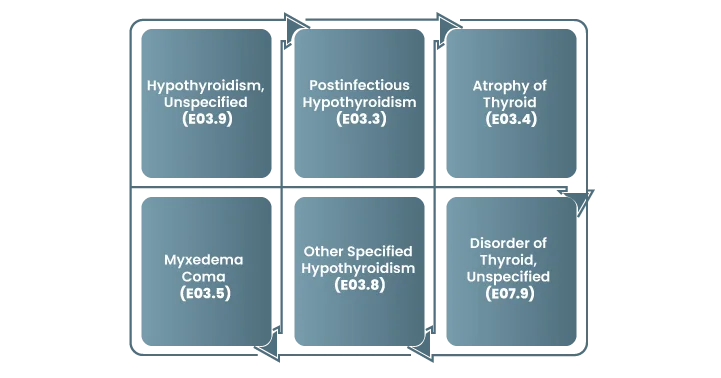
Hypothyroidism can appear in several different forms, and each type has its own characteristics and ICD-10 code. Knowing the differences between these conditions is important for accurate coding, proper documentation, and successful medical billing.
Subclinical Hypothyroidism:
Subclinical hypothyroidism is a mild form of hypothyroidism in which the thyroid gland does not produce enough thyroid hormones to fully meet the body’s needs.
Iodine is an essential mineral that helps the thyroid gland produce the hormones thyroxine (T4) and triiodothyronine (T3). These hormones regulate metabolism, energy production, and many other important body functions. The subclinical hypothyroidism ICD 10 code is E02.
Atrophy of thyroid:
Thyroid atrophy is a condition in which the thyroid gland becomes smaller or shrinks over time. This usually happens because of underlying medical conditions and often leads to reduced thyroid function. It is also referred to as acquired hypothyroidism, and E03.4 is used as acquired hypothyroidism icd 10.
Post-surgical Hypothyroidism:
Post-surgical hypothyroidism, also called post-thyroidectomy hypothyroidism, develops after part or all of the thyroid gland has been surgically removed. E89.0 is coded as Postprocedural hypothyroidism icd 10.
History of Hypothyroidism:
When documenting a patient’s medical history that includes hypothyroidism, use Z83.3 (Family history of other endocrine, nutritional and metabolic diseases).
Postprocedural Hypothyroidism:
This condition is also coded as E89.0 and refers to hypothyroidism that develops after a medical or surgical procedure, making it similar to post-surgical hypothyroidism.
Secondary Hypothyroidism:
Secondary hypothyroidism occurs when the pituitary gland or hypothalamus does not properly stimulate the thyroid gland, causing reduced thyroid hormone production. The code is E23.0 (Hypopituitarism).
Other Specified Hypothyroidism:
If the patient’s hypothyroidism does not fall into the common categories but has been specifically identified by the provider, use E03.8.
Postoperative Hypothyroidism:
Postoperative hypothyroidism is coded as E89.0, the same code used for post-surgical and postprocedural hypothyroidism.
Autoimmune Hypothyroidism:
Autoimmune hypothyroidism, also known as Hashimoto’s thyroiditis, is one of the most common thyroid disorders. It develops when the body’s immune system mistakenly attacks the thyroid gland, causing inflammation and reducing its ability to produce thyroid hormones. The autoimmune hypothyroidism icd 10 code is E06.3.
Coding Guidelines for Hypothyroidism
ICD-10 codes provide a high level of specificity, allowing healthcare providers to accurately document the exact type and severity of hypothyroidism. This level of detail is important not only for creating effective treatment plans but also for ensuring accurate medical billing and insurance claims.
For example, it is important to identify whether the patient has congenital, acquired, drug-induced, or postprocedural hypothyroidism because each condition requires a different ICD-10 code. In addition, documenting any related conditions or comorbidities helps provide a complete clinical picture while improving billing accuracy.
The move from ICD-9 to ICD-10 introduced greater detail and better international standardization in healthcare documentation. Because coding guidelines continue to change, healthcare providers and medical billers should stay updated with the latest ICD-10 revisions to maintain accurate diagnosis coding, improve reimbursement, and support efficient administrative processes.
Final Words
As we conclude this guide on hypothyroidism and its ICD-10 coding, one thing is clear accuracy and specificity are essential in medical billing. Understanding the different forms of hypothyroidism, their symptoms, and the correct ICD-10 codes helps healthcare providers and medical billers submit cleaner claims and reduce coding errors.
If you want to learn more, need help with medical billing challenges, or are looking to outsource medical billing services, get in touch with the Medmax RCM known as the best medical billing company in USA!


Emily Thompson
Emily Thompson is a Revenue Cycle Management (RCM) Specialist with extensive experience in the medical billing industry. She helps healthcare organizations and medical billing companies improve claim efficiency, reduce A/R backlogs, and implement data-driven RCM strategies. Emily’s articles focus on end-to-end medical billing services, denial prevention, and technology-driven revenue optimization for healthcare practices across the U.S.