

ICD 10 Codes for Skin Tags Coding, Billing, and Documentation Guide
Skin tags, also known as acrochordons, are common benign skin growths that affect millions of patients each year. Although they are medically harmless, they are among the minor dermatology procedures that can be frequently miscoded. Payers require accurate diagnosis coding to distinguish medically necessary removals, such as those performed for irritation, bleeding, or infection, from cosmetic procedures that are generally not covered.
For medical billers, coders, and providers, choosing the correct skin tag ICD 10 code is important for accurate reimbursement, compliance, and reducing claim denials. As payer scrutiny of dermatology procedures continues to increase, precise diagnosis coding and supporting documentation have become increasingly important.
Many payers now expect stronger documentation demonstrating medical necessity before approving skin tag removal claims. Using the appropriate skin tag ICD 10 code along with detailed clinical documentation can help practices reduce denials, support compliance, and improve reimbursement outcomes.
This guide explains the primary skin tag ICD 10 code, when related codes may apply, how diagnosis codes align with CPT procedure codes, and the documentation practices that can help keep skin tag removal claims accurate and clean.

Table of Contents
ToggleWhat Are Skin Tags?
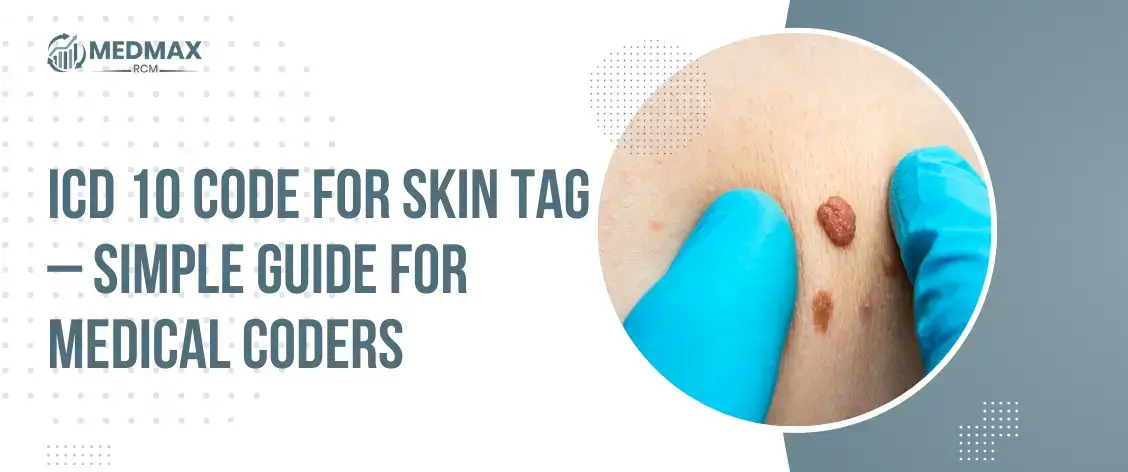
A skin tag is a small, soft, non-cancerous growth that hangs off the skin by a tiny stalk of tissue. Its medical name is an acrochordon.
Skin tags (acrochordons) are small, soft, benign skin growths that commonly develop on the neck, eyelids, armpits, groin, or under the breasts. They are usually painless but may become uncomfortable when irritated by clothing, jewelry, or repeated friction. Skin tags are more common in adults over 45 and may occur more frequently in people who are overweight or have type 2 diabetes, although they can develop in anyone regardless of age or health status.
Cosmetic vs Medically Necessary:
- Cosmetic: Removal performed for appearance alone is generally not covered by most payers.
- Medically necessary: Removal may be considered medically necessary when skin tags cause symptoms such as bleeding, irritation, recurrent inflammation, or interference with normal daily activities.
Primary ICD-10 Code for Skin Tags
L91.8 – Other hypertrophic disorders of the skin
L91.8 is the ICD 10 code commonly used to report skin tags (acrochordons). It falls under hypertrophic disorders of the skin and may be used when removal is medically justified rather than performed solely for cosmetic reasons.
The ICD-10-CM code L91.8 is commonly used for documenting skin tags. When removal is medically necessary, the diagnosis should be supported by clear clinical documentation describing the symptoms or functional problems associated with the lesions.
| Field | Detail |
|---|---|
| Code | L91.8 |
| Description | Other hypertrophic disorders of the skin |
| Billable | Yes |
| Typical use | Skin tags with documented symptoms supporting removal |
| Payer note | Always verify the payer's specific medical necessity policy |
Skin tags are generally harmless, but they may require removal when they cause irritation, bleeding, recurrent inflammation, pruritus, or interfere with movement or vision. In these situations, L91.8 may support the diagnosis when the provider’s documentation establishes medical necessity.
Correct use of L91.8 requires specific documentation. Providers should record the number of lesions, their location (such as the neck, eyelid, groin, armpit, or perianal area), and the symptoms supporting removal. For example, documenting that “skin tags on the eyelid cause irritation and blurred vision” provides clinical detail supporting the reason for treatment. When tags are removed, coders commonly report L91.8 with CPT 11200 (up to 15 lesions) or CPT 11201 (each additional 10 lesions), when applicable.
Billable vs Non-Billable Skin Tag Coding
Payer review often focuses on whether skin tag removal was medically necessary or performed solely for cosmetic purposes. For this reason, it is important to distinguish medically necessary skin tag removal from cosmetic removal.
- Billable when medically necessary: L91.8 may be reported when the skin tag causes documented irritation, bleeding, friction, inflammation, or functional problems.
- Non-billable or self-pay when cosmetic: Z41.1 may apply when the service is performed strictly for cosmetic purposes.
- Key point: Cosmetic-only removal is generally not covered by insurance. Patients should be informed of their financial responsibility before the procedure when required by payer or practice policy.
This distinction is important because some claims are denied not because the diagnosis code is incorrect, but because the procedure does not meet the payer’s coverage or medical necessity requirements.
Additional ICD-10 Codes by Location and Type
Although L91.8 is commonly used for skin tags, other ICD-10 codes may apply depending on the patient’s condition, the location of the lesion, or how the provider documents the diagnosis. These distinctions are particularly relevant in dermatology coding, where documentation may need to identify the lesion type, location, and associated symptoms.
| Code | Description | When to use |
|---|---|---|
| L91.8 | Other hypertrophic disorders of the skin | Commonly used for neck, armpit, groin, and other general-site skin tags |
| K64.4 | Residual hemorrhoidal skin tags | Used for residual hemorrhoidal skin tags rather than defaulting to L91.8 |
| H02.9 | Unspecified disorder of eyelid | May apply to eyelid lesions when the documentation supports an eyelid disorder or related functional issue |
| D23.9 | Benign neoplasm of skin, unspecified | May apply when the provider documents the lesion as a benign neoplasm and the diagnosis supports this code |
| L98.8 | Other specified disorders of the skin and subcutaneous tissue | May be considered for lesions that are documented as a specified skin disorder not classified elsewhere |
| Q82.8 | Other specified congenital malformations of skin | May apply to congenital skin lesions present from birth rather than acquired skin tags |
Location-Specific Considerations
Skin tags can occur in multiple areas of the body, and the documented diagnosis may vary based on the lesion’s location and clinical characteristics:
- Neck/Armpits/Groin – L91.8 is commonly used unless another diagnosis is specifically documented.
- Eyelid – H02.9 or L91.8 may be considered depending on the documented diagnosis and functional issue.
- Perianal/hemorrhoidal region – K64.4 may apply when the lesion is documented as a residual hemorrhoidal skin tag.
- Other skin sites – D23.9 or L98.8 may apply when the provider’s documentation supports a benign neoplasm or another specified skin disorder.
Location alone does not establish medical necessity. Providers should document why the lesion is being removed and how it affects the patient. For eyelid lesions, this may include irritation, visual obstruction, or repeated trauma. For perianal lesions, documentation should establish that the finding is consistent with a residual hemorrhoidal skin tag rather than a nonspecific skin lesion.
Common Coding Errors with Skin Tags
- Using L91.8 for purely cosmetic removal, which may result in a denial when the payer does not cover cosmetic services.
- Failing to correctly pair the ICD-10 diagnosis with the applicable CPT procedure code.
- Omitting documentation of medical necessity, since even an appropriate ICD-10 code may not support reimbursement without documented symptoms.
- Confusing hemorrhoidal skin tags with general skin tags when the documentation supports K64.4.
- Using a location-based diagnosis without sufficient clinical documentation.
- Missing the lesion count or procedure method in the procedure or operative note.
Accurate skin tag coding requires more than simply entering L91.8. Payers may review whether the diagnosis is supported by the documented location, symptoms, medical necessity, and appropriate CPT code pairing.
Following consistent coding and documentation practices can help providers and medical billers reduce avoidable denials, support compliance, and capture appropriate reimbursement for medically necessary skin tag removal.
CPT Codes for Skin Tag Removal
Diagnosis coding should be appropriately paired with procedure codes when skin tags are removed. The most common CPT codes used for skin tag removal include:
CPT 11200 – Removal of Skin Tags, Up to and Including 15 Lesions
CPT 11200 is reported when a provider removes up to 15 skin tags during the same encounter. Depending on the clinical situation, removal may involve snip excision, electrocautery, cryotherapy, or another applicable technique. Documentation should identify the total number of lesions removed, their location, the removal method, and the medical necessity supporting the procedure.
CPT 11201 – Each Additional 10 Lesions
CPT 11201 is an add-on code used with CPT 11200 when more than 15 skin tags are removed during the same session. Providers should document the total number of lesions and relevant treatment details to support accurate coding and reduce the risk of payer review or claim denials.
Coding tip: Documentation supporting the CPT codes should include:
- Number of tags removed.
- Method of removal (snip excision, cryotherapy, cautery, etc.).
- Medical necessity (such as irritation, bleeding, or recurrent infection).
Medical Necessity Requirements for Skin Tag Removal
Selecting the correct diagnosis code does not by itself guarantee reimbursement. Most payers require documentation showing that skin tag removal was medically necessary rather than performed solely for cosmetic reasons.
Commonly Covered Situations
- Recurrent irritation from clothing or jewelry
- Bleeding or recurrent trauma
- Infection or inflammation
- Functional impairment
- Obstruction of vision caused by eyelid lesions
- Persistent discomfort affecting daily activities
Commonly Non-Covered Situations
- Cosmetic concerns only
- Removal requested for appearance-related reasons
- Patient preference without documented symptoms or medical necessity
Because payer policies can vary, documenting the specific symptoms and clinical reason for removal is important when establishing medical necessity and supporting the claim.
Documentation Best Practices
To help reduce denials, providers should document the following details:
- Medical necessity: Clearly indicate irritation, bleeding, infection, obstruction, or another documented clinical reason for removal.
- Location: Specify where the skin tags are located.
- Quantity: Record the number of lesions removed.
- Method: Document how the lesions were removed.
- Patient symptoms: Note discomfort, interference with daily activities, or recurrent irritation/infections when applicable.
Good documentation should also clearly distinguish cosmetic treatment from medically necessary care. If the medical record states that the patient requested removal solely for appearance, the service generally should not be represented as a covered medically necessary procedure.
Partner with dermatology coding specialists to help reduce denials and improve reimbursement outcomes.
- No more resubmitting again and again 97% Claim Approval Rate
- No delays, no backlog, just clean submissions 24-hour Claim Turnaround
- 100% HIPAA-compliant, audit-proof systems HIPAA Compliance
- Track every dollar and denial in real time Weekly, Monthly Reports
Skin Tag Coding Expertise for Dermatology Practices
Accurate skin tag ICD-10 coding involves more than assigning a diagnosis code. Consistent reimbursement depends on complete clinical documentation, appropriate CPT and ICD-10 code pairing, medical necessity validation, and compliance with payer-specific billing requirements. As payer scrutiny continues, dermatology practices benefit from structured coding and billing processes that help protect revenue while reducing compliance risk.
Medmax RCM helps dermatology practices strengthen reimbursement through specialized coding expertise, documentation reviews, coding quality audits, denial prevention, and end-to-end revenue cycle management. Our dermatology-focused billing teams work closely with providers to improve claim accuracy, reduce coding-related denials, and support reimbursement across medical and surgical dermatology services.
By combining specialty-specific coding knowledge with proactive revenue cycle management, Medmax RCM helps practices reduce claim risk, improve collections, and build a more predictable and financially resilient revenue cycle.





Jessica Collins
Jessica Collins is a Certified Professional Coder (CPC) specializing in medical billing services and revenue cycle management (RCM). She works closely with healthcare providers and medical billing companies to streamline claim processing, reduce denials, and enhance reimbursement efficiency.