

ICD-10 Code for Knee Pain M25.561, M25.562 : A Complete Guide
Healthcare providers must use complete and accurate diagnosis codes that include all the important details about a patient’s condition and treatment. One area that often creates challenges is coding for knee conditions. Since knee pain is a common reason patients visit orthopedic specialists, it is important for medical coders to understand how the ICD-10-CM system classifies different knee diagnoses.
This guide explains ICD-10 coding for knee pain in a simple and practical way. We will cover the basics of ICD-10-CM, review the most common knee pain diagnosis codes, discuss the factors that affect code selection, and highlight common coding mistakes to avoid. By understanding these guidelines, you can improve coding accuracy and support smoother orthopedic billing.
Table of Contents
ToggleThe Basics of ICD-10-CM
The International Classification of Diseases, 10th Revision, Clinical Modification (ICD-10-CM) is the standard coding system used to document patient diagnoses in healthcare. It includes more than 70,000 diagnosis codes and provides much greater detail than the older ICD-9 system.
Each ICD-10 code contains letters and numbers that describe a patient’s condition with greater accuracy. For knee pain, these codes identify details such as the affected side (right or left knee), the underlying condition, and the severity of the problem. Accurate coding helps reduce claim denials, improves communication between healthcare providers and insurance companies, and supports faster reimbursement.
For example, the M25.561 diagnosis code is used for pain in the right knee. This code clearly identifies the affected side, making the diagnosis more specific and improving claim accuracy.
Some Common Codes For Knee Pain
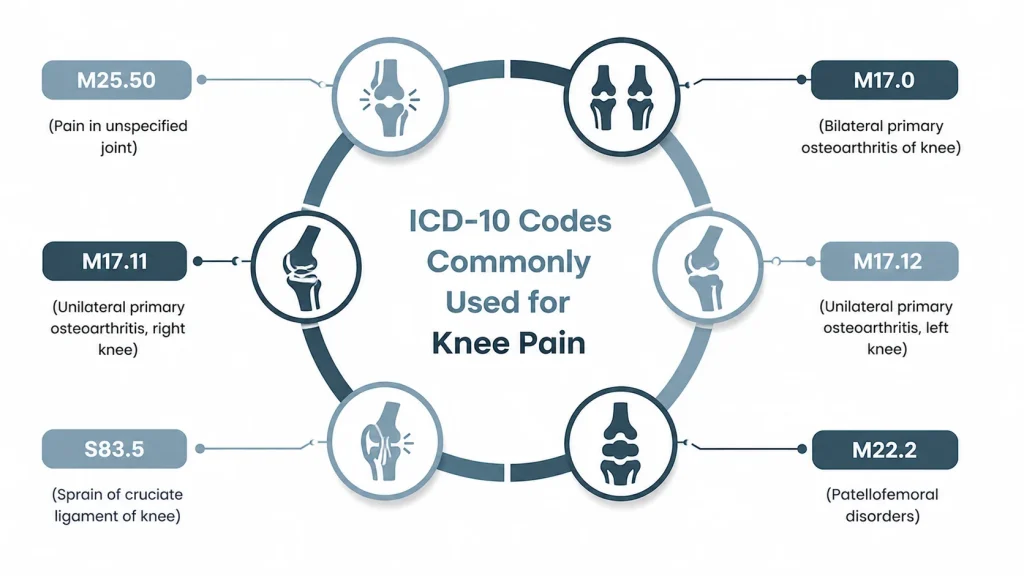
M25.50 Pain in Unspecified Joint
M25.50 is an unspecified ICD-10 code used for pain in an unspecified joint. While this code may be appropriate in limited situations, coders should avoid using it whenever more detailed information is available. General codes can increase the risk of claim denials or delay workers comp collections.
Before selecting this code, review the patient’s medical documentation carefully and identify the exact joint involved, such as the knee.
Whenever possible, use more specific diagnosis codes like M25.561 for right knee pain or M25.562 for left knee pain. Specific coding improves billing accuracy and reduces reimbursement delays.
Example Usage:
If the medical record simply states “generalized joint pain” without identifying the affected joint, M25.50 may be appropriate. However, if additional clinical information later confirms that the pain is in the knee, the diagnosis should be updated to the correct and more specific code.
M17.0 Bilateral Primary Osteoarthritis of the Knees
Knee osteoarthritis is one of the leading causes of chronic knee pain and affects millions of people every year. The ICD-10 code M17.0 identifies bilateral primary osteoarthritis, meaning that both knees are affected by degenerative joint disease.
Older adults are especially at risk for this condition. According to the Centers for Disease Control and Prevention (CDC), more than 32.5 million adults in the United States have osteoarthritis, and the knees are among the most commonly affected joints.
When providing orthopedics billing services, medical billers should always confirm that both knees are involved before assigning this diagnosis code.
Clinical Scenario:
A 70-year-old patient reports gradually worsening pain in both knees. X-rays confirm osteoarthritis in each knee. In this situation, the correct diagnosis code is M17.0.
M17.11 - Unilateral Primary Osteoarthritis, Right Knee
The ICD-10 code M17.11 is used for unilateral primary osteoarthritis affecting the right knee. This condition commonly develops because of aging, long-term wear and tear, previous injury, or repeated stress on the joint.
Correctly documenting whether osteoarthritis affects one knee or both knees is very important for accurate claim processing.
If laterality is not documented, insurance claims may be delayed or rejected. Always review the patient’s medical record carefully to confirm which knee is affected before assigning the diagnosis code.
Real-Time Tip:
Along with laterality codes such as M17.11 and M17.12, document any treatment the patient has received, including corticosteroid injections, physical therapy, or other conservative treatments. Complete documentation strengthens coding accuracy and supports successful reimbursement.
M17.12 - Unilateral Primary Osteoarthritis, Left Knee
Like M17.11, M17.12 is used to report unilateral primary osteoarthritis of the left knee. Providers and coders should carefully review imaging reports, physician notes, and other clinical documentation to verify that the left knee is affected.
Accurate code selection is especially important before procedures such as knee replacement surgery because insurance companies often review the diagnosis carefully before approving treatment.
For example, Medicare generally requires detailed clinical documentation before authorizing surgery for chronic knee osteoarthritis.
| ICD-10-CM Code | Description |
|---|---|
| M25.562 | Pain in left knee |
| M25.561 | Pain in right knee |
| M25.569 | Pain in unspecified knee |
| M17.12 | Unilateral primary osteoarthritis, left knee |
| M17.32 | Unilateral post-traumatic osteoarthritis, left knee |
| M17.2 | Bilateral primary osteoarthritis of knee |
| M17.11 | Unilateral primary osteoarthritis, right knee |
| M23.202 | Derangement of unspecified lateral meniscus due to old tear or injury, left knee |
| M23.212 | Derangement of anterior horn of lateral meniscus due to old tear or injury, left knee |
| M23.222 | Derangement of posterior horn of lateral meniscus due to old tear or injury, left knee |
| M23.302 | Other meniscus derangements, unspecified lateral meniscus, left knee |
| M23.002 | Cystic meniscus, unspecified lateral meniscus, left knee |
| M23.602 | Other spontaneous disruption of unspecified ligament of left knee |
| M22.12 | Recurrent subluxation of patella, left knee |
| M22.2X2 | Patellofemoral disorders, left knee |
| M22.2X1 | Patellofemoral disorders, right knee |
| M22.2X9 | Patellofemoral disorders, unspecified knee |
| M76.50 | Patellar tendinitis, unspecified knee |
| M76.52 | Patellar tendinitis, left knee |
| M70.52 | Other bursitis of left knee |
| M70.42 | Prepatellar bursitis, left knee |
| G89.29 | Other chronic pain |
| G89.4 | Chronic pain syndrome |
S83.5 - Sprain of Cruciate Ligament of the Knee
Ligament sprains are among the most common knee injuries. The S83.5 code is used to report sprains of the cruciate ligament, which frequently occur during sports and other high-impact activities.
Cruciate ligament injuries, including ACL and PCL tears, often happen because of sudden twisting movements or direct impact. Several S83.5 subcategories provide additional details about the affected ligament, the injured side, and the severity of the injury.
Accurate documentation should include:
- The severity of the sprain (Grade I, II, or III)
- Whether imaging studies confirmed the diagnosis
- Any rehabilitation or treatment already started
M22.2 - Patellar Instability
Some knee conditions involve the kneecap, also known as the patella. M22.2 is used to report patellar instability, a condition in which the kneecap partially or completely moves out of its normal position. This may result from injury, weak supporting tissues, or certain inherited conditions.
Using accurate diagnosis codes such as M22.2 helps support medical necessity for treatments like patellar braces, rehabilitation, or muscle-strengthening therapy.
Coding professionals should also review clinical notes for additional details, including whether the patient has experienced repeated patellar dislocations.
Factors Affecting the Selection of Correct Codes
Several important factors should be reviewed before selecting the correct diagnosis code for knee pain.
- Laterality: Determine whether the condition affects the right knee, left knee, or both knees.
- Underlying Cause: Identify the condition causing the pain, such as osteoarthritis, ligament injury, meniscus damage, or another diagnosis.
- Chronicity: Document whether the condition is acute or chronic, as each may require different diagnosis codes.
- Documentation Specificity: Always choose the most specific diagnosis code available. General codes should only be used when sufficient clinical details are not available.
Tips for Accurate Coding and Avoiding Mistakes
Follow these best practices to improve coding accuracy for knee pain:
- Match every diagnosis code with the provider’s clinical documentation.
- Review annual ICD-10 updates since new codes and revisions are released regularly.
- Use coding software or encoder tools to stay current with coding guidelines.
- Follow payer-specific billing requirements, especially for workers’ compensation claims, to reduce denials and payment delays.
Elevate Your Coding Efficiency
Coding knee pain accurately requires a strong understanding of ICD-10 guidelines and careful attention to clinical documentation. Whether the diagnosis involves osteoarthritis, ligament injuries, or patellar disorders, using the correct diagnosis codes such as M17.0, M17.12, and S83.5 helps support accurate billing, timely reimbursement, and quality patient care.
The best way to master the ICD-10 coding system is through continuous learning and regular practice. Improving your coding accuracy not only reduces claim denials but also supports proper treatment documentation and helps healthcare providers receive timely payment for the services they deliver.





Emily Thompson
Emily Thompson is a Revenue Cycle Management (RCM) Specialist with extensive experience in the medical billing industry. She helps healthcare organizations and medical billing companies improve claim efficiency, reduce A/R backlogs, and implement data-driven RCM strategies. Emily’s articles focus on end-to-end medical billing services, denial prevention, and technology-driven revenue optimization for healthcare practices across the U.S.