

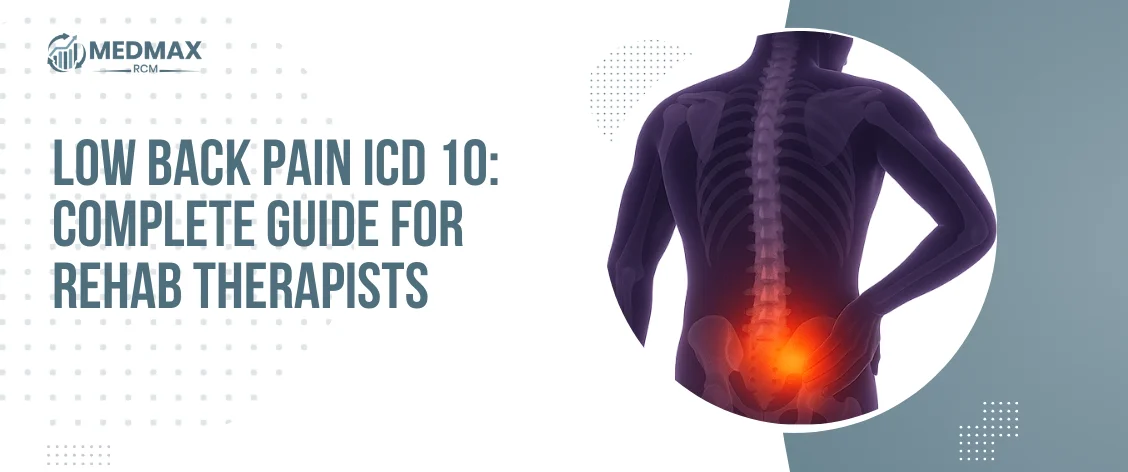
ICD 10 Code for Low Back Pain
Not every case of low back pain presents in the same way. Understanding how and when to use M54.50 can help clinicians document patient conditions accurately while meeting payer and coding requirements.
Clear, thorough documentation is important in outpatient rehabilitation, where accurate coding can affect both patient care and reimbursement. When selecting a low back pain ICD-10 code, clinicians should ensure the diagnosis is medically supported and specific enough to reflect the patient’s presentation.
This is particularly important when using M54.50, the code for “low back pain, unspecified.” Although it can be appropriate for nonspecific or early-stage presentations, M54.50 should be supported by documentation that explains the clinical reasoning behind choosing a broad diagnosis rather than a more specific one.
In this article, we’ll review when and how to use M54.50, discuss documentation best practices, and cover common coding mistakes to help keep your clinical notes accurate, defensible, and aligned with payer expectations.
Table of Contents
ToggleUnderstanding Low Back Pain ICD-10 Codes
When documenting low back pain, choosing the most appropriate level of specificity is important. The ICD-10 system includes several diagnosis codes that identify different causes, symptoms, and anatomical presentations of low back pain. This allows clinicians to create more accurate documentation and develop appropriate treatment plans.
Some commonly used low back pain ICD-10 codes in outpatient rehabilitation include:
M54.50: Low back pain, unspecified
M54.4x: Lumbago with sciatica (side-specific: right, left, or unspecified)
M51.36x–M51.379: Lumbar/lumbosacral disc degeneration (with or without lower extremity pain)
S39.012: Low back strain
M62.85: Dysfunction of the multifidus muscle, lumbar region
Each code represents a different clinical presentation, ranging from mechanical strain and disc-related conditions to neuromuscular dysfunction. The appropriate code should be based on evaluation findings rather than automatically selecting a general diagnosis.
But what should you do when an evaluation does not reveal a specific structural cause, or when the patient’s symptoms are still developing? Let’s examine when M54.50 is appropriate and how proper documentation can support its use.
What is Diagnosis Code M54.50?
M54.50, or “low back pain, unspecified,” is an ICD-10 diagnosis code used when a patient has lower back pain but a specific underlying cause has not been established. It may be used during an initial evaluation when symptoms are nonspecific, still developing, or when sufficient information is not yet available to support a more specific diagnosis.
The code became effective after M54.5 was retired in 2022 as part of efforts to improve diagnostic specificity.¹ The previous M54.5 code was commonly used for low back pain, while M54.50, M54.51, and M54.59 were introduced to better distinguish different low back pain presentations.

When is M54.50 the Right Code to Use?
M54.50 is most appropriate when the clinical evaluation does not support a more specific diagnosis. It can be useful early in an episode of care when symptoms are nonspecific and the condition has not yet been clearly established.
Use M54.50 when:
- The patient reports generalized lumbar pain without red flags, neurological findings, or identifiable structural abnormalities.
- The clinical presentation remains unclear and additional monitoring or testing is needed.
- The evaluation does not currently support diagnoses such as strain, disc involvement, vertebrogenic pain, or radiculopathy.
In these circumstances, M54.50 may function as an initial or temporary diagnosis. However, the medical record should clearly explain why a more specific code was not selected. Documentation should describe the findings, relevant exclusions, and clinical reasoning supporting the broader diagnosis.
When M54.50 is not the Right Choice
M54.50 should not be used when the evaluation provides enough information to support a more specific diagnosis. Selecting an unspecified code despite clear clinical findings may inaccurately represent the patient’s condition and create compliance concerns.
Do not use M54.50 if:
- The assessment identifies paraspinal tenderness following heavy lifting. In this situation, S39.012 (low back strain) may be more appropriate.
- The patient reports leg pain, numbness, or tingling consistent with nerve involvement. M54.4x (lumbago with sciatica) may better represent the presentation.
- Imaging demonstrates vertebral endplate changes along with symptoms of deep, midline axial pain. M54.51 (vertebrogenic low back pain) may be more appropriate.
Using a more specific diagnosis when supported by the clinical findings helps create more accurate documentation and can better align coding with payer requirements. Relying on M54.50 when a more appropriate diagnosis is available may contribute to claim denials or audit concerns.
Why Nonspecific Codes Raise Red Flags
Payers and auditors may examine claims involving unspecified diagnosis codes more closely. M54.50 can suggest that the patient’s condition has not been fully characterized, particularly when the code is repeatedly used without supporting documentation. This may lead to requests for additional records, reimbursement delays, or increased audit attention.
Claims may receive additional scrutiny when nonspecific codes are used across multiple visits or are not adequately supported by evaluation findings. CMS and professional organizations emphasize the importance of diagnostic specificity and accurate documentation for compliant billing and reliable patient-care records.
For this reason, clinicians using M54.50 should clearly document their clinical reasoning and update the diagnosis when the patient’s presentation becomes more defined.
Coding compliance
The M54.50 diagnosis code has Excludes notes that prevent its use with certain other ICD-10 codes. These include:
- S39.012: Low back strain
- M51.2-: Lumbago due to intervertebral disc displacement
- M54.4-: Lumbago with sciatica
- F45.41: Psychogenic dorsalgia
Always ensure that the selected code matches the findings documented in the patient’s record. When the evaluation supports one of these more specific conditions, M54.50 should not be reported alongside it when an Excludes1 instruction applies.
Coding Best Practices for M54.50
Because M54.50 is an unspecified diagnosis code, payers may give it additional attention when it appears frequently or without sufficient supporting documentation. Inadequate documentation can contribute to claim denials, requests for medical records, or reimbursement delays.
The following information can help support the appropriate use of M54.50 in evaluation and treatment notes:
Describe the Patient’s Symptoms Clearly
Begin with a concise but complete description of the patient’s primary complaint, including:
- Location of pain (such as central lumbar or bilateral)
- Onset (sudden or gradual)
- Pain quality (dull, sharp, aching, etc.)
- Duration and frequency
- Aggravating and relieving factors
When applicable, document the absence of red flags or radicular symptoms. This can help demonstrate why more specific diagnoses, such as M54.4x or M51.2-, were not selected.
Document Functional Impact
Explain how the patient’s low back pain affects mobility, activities of daily living, work, exercise, or other meaningful activities. This information helps establish the functional impact of the condition and supports the medical necessity of rehabilitation services.
The functional limitations documented during the evaluation may also help guide the selection of exercises for low back pain, ensuring treatment is appropriate for the patient’s symptoms, functional capacity, and current level of impairment.
Include Objective Exam Findings
Support the clinical assessment with relevant objective findings, such as:
- Range-of-motion limitations
- Palpation findings, including tenderness or muscle tone
- Strength deficits
- Gait or postural abnormalities
- Neurological screening findings, when performed
Even when imaging is not available, objective examination findings can demonstrate that an appropriate evaluation was completed and that more specific diagnoses were considered.
Justify the use of M54.50 Directly
When M54.50 accurately reflects the patient’s presentation, document the reasoning behind its selection. A statement such as, “Findings support nonspecific low back pain; no current evidence of discogenic or radicular involvement,” can clearly communicate the clinical rationale.
This level of documentation shows payers and auditors that M54.50 was selected based on the evaluation rather than convenience or routine. If conditions such as strain, vertebrogenic pain, disc involvement, or sciatica have been considered and are not supported by the findings, documenting that reasoning can further strengthen the record.
Update the Code as Needed
Using M54.50 at the beginning of care does not mean the same diagnosis must remain in place indefinitely. As symptoms change or additional clinical information becomes available, the diagnosis should be reassessed and updated when appropriate.
For example, if later imaging identifies intervertebral disc degeneration and the findings correlate with the patient’s symptoms, an appropriate M51.36x–M51.379 code may be considered. If radicular symptoms develop, the diagnosis may need to be revised to an appropriate M54.4x code.
Keeping the diagnosis aligned with the patient’s current presentation helps maintain accurate documentation and can reduce potential reimbursement issues.
Related ICD Codes for Low Back Pain
When M54.50 does not accurately represent the patient’s condition, other related codes may provide greater specificity.
M54.51 – Vertebrogenic low back pain: This code may be appropriate when the clinical presentation is consistent with vertebral endplate-related pain, such as Modic changes, often involving persistent midline axial pain. Imaging may help support the diagnosis.
M54.59 – Other low back pain: This code may be used when the presentation does not fit vertebrogenic or unspecified low back pain and another type of low back pain is more appropriate.
Build the Bridge Between Evaluation and Reimbursement
Using M54.50 correctly involves more than selecting an ICD-10 diagnosis code. It requires documentation that clearly connects the patient’s symptoms, examination findings, clinical reasoning, and treatment plan. M54.50 has a valid role when low back pain is nonspecific or still being evaluated, but its use should be supported by clear and thorough documentation.
As the patient’s condition develops, the diagnosis should be reassessed and updated when new findings support a more specific code. Keeping coding consistent with the clinical picture can strengthen documentation, support appropriate care, and help reduce avoidable claim denials or reimbursement delays.
Your team may be doing everything right—but hidden billing issues could still be costing you thousands. Let us review your process and show you where you’re losing revenue. Message us today for a quick review.
- No more resubmitting again and again 97% Claim Approval Rate
- No delays, no backlog, just clean submissions 24-hour Claim Turnaround
- 100% HIPAA-compliant, audit-proof systems HIPAA Compliance
- Track every dollar and denial in real time Weekly, Monthly Reports



Emily Thompson
Emily Thompson is a Revenue Cycle Management (RCM) Specialist with extensive experience in the medical billing industry. She helps healthcare organizations and medical billing companies improve claim efficiency, reduce A/R backlogs, and implement data-driven RCM strategies. Emily’s articles focus on end-to-end medical billing services, denial prevention, and technology-driven revenue optimization for healthcare practices across the U.S.