Our Revenue Cycle Management services got you covered from medical billing and coding to denial management. Focus on patient care, leave other burdens to us!
How to Use Knee Pain ICD 10 Codes for Accurate Billing Practices
Home / ICD Codes / How to Use Knee Pain ICD 10 Codes for Accurate Billing Practices
How to Use Knee Pain ICD 10 Codes for Accurate Billing Practices
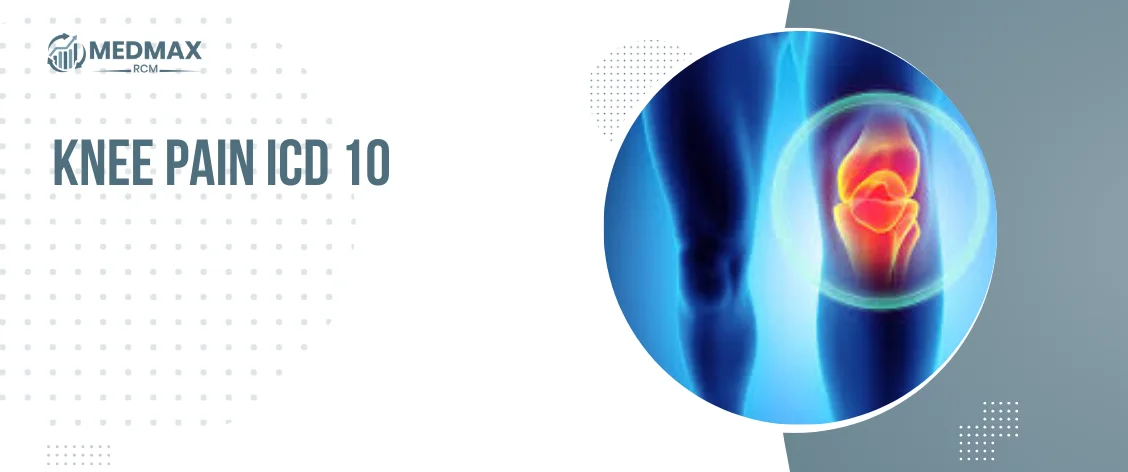
Knee pain is among the most common musculoskeletal issues treated by physical therapists. Whether it’s an acute sports injury or chronic osteoarthritis, proper treatment starts with accurate documentation and that includes selecting the correct ICD-10 code.
However, navigating ICD-10 knee pain codes is not always simple. Therapists and clinic owners must document laterality correctly, avoid common coding errors, and maintain streamlined records to keep billing accurate and compliant.
This guide covers everything physical therapy professionals should know about the ICD-10 knee pain code family including proper documentation, when to use specific codes, and how to simplify the process.
Knee pain falls under the musculoskeletal section of the ICD-10 classification system. Specifically, it is categorized under subcategory M25.56 Pain in joint, knee. This category includes three primary codes based on laterality:
ICD-10 Knee Pain Codes Table
ICD-10 Code
Description
M25.561
Pain in right knee
M25.562
Pain in left knee
M25.569
Pain in unspecified knee
These are the most frequently used ICD-10 codes for knee pain in physical therapy settings. Avoid using M25.569 unless the affected knee cannot be determined.
When to Use Each Code
Right Knee Pain ICD-10
Code: M25.561
Use when: The patient reports pain specifically in the right knee. Related keyword: ICD 10 code for right knee pain
Left Knee Pain ICD-10
Code: M25.562
Use when: Documentation confirms pain in the left knee. Related keyword: ICD 10 code for left knee pain
Bilateral Knee Pain ICD-10
Code: Use both M25.561 and M25.562
Use when: The patient presents with pain in both knees. There is no single bilateral code available in ICD-10. Related keyword: bilateral knee pain ICD 10
Unspecified Knee Pain ICD-10
Code: M25.569
Use when: Laterality is not documented or cannot be confirmed. This should only be used as a last option. Related keyword: ICD 10 code knee pain
Why Accurate Coding Matters
Correct coding is not just a technical requirement it directly affects your clinic’s revenue and compliance.
What Can Happen with Inaccurate Coding?
Claim Denials: Insurance payers may deny or delay claims if unspecified codes are overused.
Compliance Risks: Incorrect coding can increase audit exposure and potential penalties.
Incomplete Data: Precise documentation supports better tracking of treatment progress and outcomes.
Documentation Tips for Physical Therapists
Best Practices
Clearly document laterality (e.g., “left knee pain when descending stairs”).
In bilateral cases, describe symptoms for each knee individually.
Always confirm the affected side with the patient never assume.
Limit use of M25.569 to situations where laterality truly cannot be identified.
Common Mistakes to Avoid
Using unspecified codes by default
Failing to document left vs. right
Overlooking annual ICD-10 updates
Assuming bilateral pain requires only one code (both knees must be coded separately)
ICD-10 Knee Pain Code Quick Reference Table
Condition Type
Correct ICD-10 Code(s)
Notes
Right knee pain
M25.561
Must be documented clearly
Left knee pain
M25.562
Same requirement
Bilateral knee pain
M25.561 + M25.562
Code both knees
Unspecified knee pain
M25.569
Use only if laterality unavailable
General joint pain
M25.5 (parent code)
Not billable use specific subcode
How to Streamline Knee Pain ICD-10 Coding
Recommended Tools and Processes
Use structured templates with left/right checkboxes
Enable EMR alerts for incomplete coding
Conduct annual ICD-10 training for staff
Preload common conditions (e.g., ACL rehab, osteoarthritis) into documentation systems
Beyond Pain: Related Knee ICD-10 Codes for Medmax RCM
Knee pain may be the initial complaint, but evaluations often lead to more specific diagnoses that require different ICD-10 codes. Moving beyond M25.56 when appropriate improves documentation quality.
Common Related Diagnoses
Condition
ICD-10 Code
Notes
Osteoarthritis, knee
M17.0–M17.9
Use laterality-specific subcodes
Meniscus tear (traumatic)
S83.2–
Include external cause codes if needed
Patellofemoral pain syndrome
M22.2–
Common in athletic populations
Chondromalacia patellae
M22.4
Frequently seen in younger adults
Using more detailed diagnosis codes when clinically appropriate strengthens documentation and supports continued care.
Tips for ICD-10 Success Across the Care Team
When everyone in the clinic follows ICD-10 best practices, efficiency and compliance improve significantly.
Team Strategies
Front desk teams should confirm referrals include laterality.
Therapists must clearly document specifics during each visit.
Billing staff should review records before claim submission.
Practice owners should monitor denial trends and provide updated training.
Strong workflows and shared responsibility reduce costly errors and improve overall performance.
Why Medmax RCM Is the Smart Choice for ICD-10 Coding
Built-in ICD-10 search with advanced filters
Auto-fill features with laterality selection
Easy dual entry for bilateral knee pain
Instant alerts for incomplete or non-billable codes
Customizable evaluation and SOAP note templates
One-click claim submission with audit-ready workflows
With Medmax RCM, physical therapy professionals spend less time coding and more time focusing on patient care. The system keeps ICD-10 usage accurate, compliant, and fully integrated with billing operations.
Conclusion
Understanding and correctly applying knee pain ICD-10 codes especially laterality is essential for physical therapists and clinic owners. Codes such as M25.561 (right knee) and M25.562 (left knee) are standard in musculoskeletal billing, and precision is critical. In bilateral cases, always remember: two knees require two separate codes.
Whether you are billing for left knee pain ICD 10, right knee pain ICD 10, or managing a more complex rehabilitation case, clear documentation and accurate coding always work together.
Emily ThompsonMedical Billing Services
Emily Thompson is a Revenue Cycle Management (RCM) Specialist with extensive experience in the medical billing industry. She helps healthcare organizations and medical billing companies improve claim efficiency, reduce A/R backlogs, and implement data-driven RCM strategies. Emily’s articles focus on end-to-end medical billing services, denial prevention, and technology-driven revenue optimization for healthcare practices across the U.S.
Emily Thompson is a Revenue Cycle Management (RCM) Specialist with extensive experience in the medical billing industry. She helps healthcare organizations and medical billing companies improve claim efficiency, reduce A/R backlogs, and implement data-driven RCM strategies. Emily’s articles focus on end-to-end medical billing services, denial prevention, and technology-driven revenue optimization for healthcare practices across the U.S.