Our Revenue Cycle Management services got you covered from medical billing and coding to denial management. Focus on patient care, leave other burdens to us!
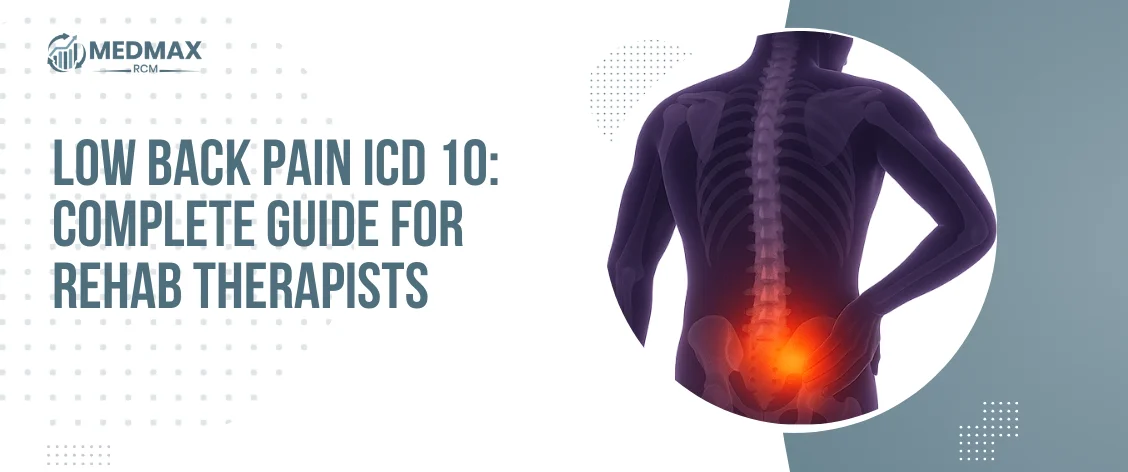
Low back pain is a problem for many patients. Just how common is it? According to the World Health Organization (WHO), 619 million people worldwide were affected by low back pain in 2020 making it the most prevalent musculoskeletal condition globally. What’s more, the WHO projects that by 2050, the number of low back pain cases will rise to 843 million as the global population continues to age.
Given this trend, rehab therapists are likely to encounter even more patients with low back pain in their physical therapy practices in the coming years. This means they need to stay current not only on treating low back pain but also on selecting the appropriate ICD-10 codes for the condition. So, which diagnosis code is the right one, and when should you code for low back pain instead of using the ICD-10 code for sciatica? We’re here to clarify and make choosing an ICD-10 code for low back pain a simpler, more straightforward process.
NIAMS also highlights that chronic low back pain can result from several factors, including:
Mechanical or structural problems, such as strains, sprains, or degenerated or ruptured discs
Inflammatory conditions, like ankylosing spondylitis
Other conditions, such as osteoporosis, infections, or back pain during pregnancy
What’s the ICD-10 Code for Low Back Pain?
Coding for low back pain has evolved in recent years. Until a few years ago, therapists could use ICD-10 code M54.5 for low back pain but CMS removed this code as of the 2022 final rule. Because M54.5 was widely used among rehab therapists, a replacement was needed. CMS introduced three new, more specific ICD-10 codes to replace it:
M54.50 (Low back pain, unspecified)
M54.51 (Vertebrogenic low back pain)
M54.59 (Other low back pain)
Therapists should now use these updated codes for low back pain patients instead of the old M54.5 code.
When Is Coding M54.50 Appropriate?
In ICD-10 coding, specificity is key. M54.50 is for low back pain, unspecified. The descriptor also covers loin pain and lumbago with non-organic signs and symptoms (NOS). However, if a more specific ICD-10 code applies to a patient, that code should be used instead.
Excludes1 edits for M54.50 include:
Low back strain (S39.012)
Lumbago due to intervertebral disc displacement (M51.2-)
Lumbago with sciatica (M54.4-)
Additionally, the M54 parent codes exclude psychogenic dorsalgia (F45.41).
When Should I Use M54.51?
M54.51 is for vertebrogenic low back pain caused by damage to the vertebral endplates. According to the Cleveland Clinic, symptoms include a deep, burning, or aching pain in the middle lower back, often worsened by prolonged sitting or physical activity.
Some common causes are:
Family history of low back pain
Obesity
Smoking
Physically demanding jobs
Tall stature
Everyday wear and tear
Excludes1 edits for M54.51 are:
Low back strain (S39.012)
Lumbago due to intervertebral disc displacement (M51.2-)
Lumbago with sciatica (M54.4-)
Psychogenic dorsalgia (F45.41)
When to Use M54.59?
ICD-10 coding emphasizes specificity, especially for CMS and commercial payer reimbursement. M54.59 is labeled simply as “Other low back pain,” and is generally used only if no other more specific code applies.
Excludes1 edits for M54.59 are the same as M54.50 and M54.51:
Low back strain (S39.012)
Lumbago due to intervertebral disc displacement (M51.2)
Lumbago with sciatica (M54.4)
Psychogenic dorsalgia (F45.41)
What is Lumbago?
If you’ve been in rehab therapy for some time, you may have heard the term lumbago essentially another name for low back pain, though it’s less commonly used today.
Lumbago is distinct from sciatica, although the two are often mentioned together. Some patients with low back pain also experience pain radiating down the leg, caused by sciatic nerve injury.
ICD-10 codes for lumbago with sciatica include:
M54.40 Lumbago with sciatica, unspecified side
M54.41 Lumbago with sciatica, right side
M54.42 Lumbago with sciatica, left side
ICD-10 Codes for Low Back Pain Due to Disc Degeneration
Starting October 1, 2024, codes M51.36 (other intervertebral disc degeneration, lumbar region) and M51.37 (lumbosacral region) will be removed and replaced with more specific codes.
New codes replacing M51.36:
M51.360: lumbar region with discogenic back pain only
M51.361: lumbar region with lower extremity pain only
M51.362: lumbar region with discogenic back pain and lower extremity pain
M51.369: lumbar region without mention of lumbar back pain or lower extremity pain
New codes replacing M51.37:
M51.370: lumbosacral region with discogenic back pain only
M51.371: lumbosacral region with lower extremity pain only
M51.372: lumbosacral region with discogenic back pain and lower extremity pain
M51.379: lumbosacral region without mention of lumbar back pain or lower extremity pain
M62.85: dysfunction of the multifidus muscles, lumbar region
Since multifidus dysfunction is related to non-specific low back pain, M62.85 may sometimes be the most appropriate code. As always, use clinical judgment and back coding decisions with documentation.
Where Can I Learn More About Sciatica?
If you want more information on low back, leg, and foot pain, check out our blog on ICD-10 codes for sciatica, along with details on the condition and its treatment.
With this guide, you should feel more confident handling cases of acute or chronic low back pain in your physical therapy clinic. For additional guidance, explore our blogs on ICD-10 coding for difficulty walking or generalized weakness.
Conclusion
Understanding the ICD-10 codes for low back pain is essential for accurate documentation and proper billing. Whether you’re coding for chronic low back pain ICD-10, lower back pain ICD-10, or using the specific ICD-10 code for low back pain, choosing the right ICD codes ensures compliance and helps improve patient care. Staying up-to-date on the latest low back pain ICD 10 guidelines makes coding easier and supports better outcomes in your physical therapy practice.
Frequently Asked Questions
What is the ICD-10 Code for Bilateral Low Back Pain without Sciatica?
ICD-10 Coding for Chronic Bilateral Low Back Pain Without Sciatica(M54. 50) Complete ICD-10-CM coding and documentation guide for Chronic Bilateral Low Back Pain Without Sciatica. Includes clinical validation requirements, documentation requirements, and coding pitfalls.
What Does Lower Back Pain without Sciatica Mean?
Lower back pain without sciatica typically indicates a localized mechanical issue, such as a muscle strain, ligament sprain, or spinal arthritis, rather than a nerve root compression. Unlike sciatica, which causes shooting leg pain, this type of pain is confined to the lumbar region and is often caused by poor posture, heavy lifting, or age-related degeneration.
How to Code Chronic Low Back Pain?
The primary ICD-10-CM diagnosis code for unspecified chronic low back pain is M54.50 (Low back pain, unspecified). For more specific, documented diagnoses, alternatives include M54.51 (Vertebrogenic low back pain) or M54.59 (Other low back pain). Use G89.29 as a secondary code for chronic pain management.
What is the Diagnosis Code Z71 89?
ICD-10-CM code Z71.89 is used for “Other specified counseling”. It is a billable, specific code for outpatient encounters involving professional advice or counseling on psychosocial issues, lifestyle adjustments, or stress management not covered by other specific codes. It does not indicate a current illness or injury.
Emily ThompsonMedical Billing Services
Emily Thompson is a Revenue Cycle Management (RCM) Specialist with extensive experience in the medical billing industry. She helps healthcare organizations and medical billing companies improve claim efficiency, reduce A/R backlogs, and implement data-driven RCM strategies. Emily’s articles focus on end-to-end medical billing services, denial prevention, and technology-driven revenue optimization for healthcare practices across the U.S.
Emily Thompson is a Revenue Cycle Management (RCM) Specialist with extensive experience in the medical billing industry. She helps healthcare organizations and medical billing companies improve claim efficiency, reduce A/R backlogs, and implement data-driven RCM strategies. Emily’s articles focus on end-to-end medical billing services, denial prevention, and technology-driven revenue optimization for healthcare practices across the U.S.